• Beijing

    25 Eylül 2019, Çin ⋅ ☀️ 26 °C

    After one last overnight train trip, one final epic journey through Chinese customs and immigration and a five hour wait in the customs hall while they changed the bogies on the train, we made it!

    We have now traveled from Helsinki to Beijing by seven trains, including six nights spent rattling and swaying along trying to sleep and trying to avoid using the toilet.

    October 1, 2019 marks the 70th anniversary of the formation of the People’s Republic of China, and there seemed to be more portaloos than bicycles on the pavement in preparation for the forthcoming celebrations.

    The Forbidden City was closed in preparation for the ceremony, but we did the walk around Tiananmen Square in 32 degree heat, watching people lining up in the shadows cast by the flagpoles, the only shade available.

    We also visited the Temple of Heaven, complete with lanterns installed in the trees and a giant video screen behind the Temple of Prayers for Good Harvests.

    That was all we had time for in Beijing, although Don and Kim have two more days to explore the Great Wall and look around a bit more.

    It has been a fascinating trip, replete with reminders of how little we really know about the rest of the world no matter how smart we think we are. For example:

    They had built a whole new MRT line in Singapore that we had never heard of.

    Sometimes countries change the design of their currency. We brought British five pound notes, and a whole lot of Chinese yuan from home, carefully saved from previous trips and now no longer legal tender.

    First class on a Chinese train is not nearly the equal of first class on a Russian one, but did come with a (male) carriage attendant who snorted, hacked and spat constantly into the rubbish bins. Unlike our Russian experience it also didn’t come with drinking water or cups, which did lead to some improvisation and some urgent shopping excursions on remote Mongolian railway stations.

    Just because a short, chubby, middle aged Chinese woman in tight jeans and a cowboy hat says a “steak” restaurant is any good doesn’t mean it is. Especially when she has a loud, grating voice and dismisses our questions with “Listen to me!”, and keeps turning the pages of the menus while we are trying to look at them. Actually, this wasn’t a mistake - we knew it would be no good but her performance was so bewilderingly funny we were unable to get up and leave.

    This has been a marvellous trip, full of new sights and experiences (almost all good ones) and shared with great, funny, caring friends. We are rather lucky.
    Okumaya devam et

  • Ulaanbaatar

    22 Eylül 2019, Moğolistan ⋅ 🌙 6 °C

    Our latest adventure started with a view from the train window of beautiful Lake Baikal, soon after which the train stopped in the middle of nowhere for two hours.

    This meant there was no time to shop at any intermediate stops, so we had a dinner of instant noodles and a few pistachios.

    In the middle of the night we crossed the border, an exercise which kept us awake for about three hours as two sets of customs people successively searched the entire train. The Mongolian guy even ripped the carpet from the floor.

    When we awoke we were in a new landscape altogether, with rolling grassy hills, roaming livestock and the occasional small settlement. Soon enough, though this gave way to Ulaanbaatar, a place not even its mother could call beautiful.

    Ulaanbaatar is a city of superlatives. Coldest capital city. Most polluted. Most congested. Craziest, most un-rule-obeying drivers.

    We stayed in the high-rise Khuvsgul Lake Hotel, very nice although lacking some of the finer details, for example in the Brickwoods’ case a door that could be locked. The room key was required to operate the elevators, but it only worked intermittently , so we had many a tedious and unwanted ride down to reception to get them to send us up to our floor using a master key.

    Chinggis Khaan Square, nearby to our hotel, is a vast public square surrounded by very attractive buildings, the centrepiece of which is the imposing Parliament House, with statues of Chinggis himself (looking a bit too obese to do much looting and pillaging, it must be said) flanked by a son and a grandson. The square is possibly also the only tidy, well-paved area in the entire city.

    We got out of town for a day and visited the edge of Gorkhi-Terelj National Park, about sixty kilometres out of town.

    On the way we dropped into the Chinggis Khaan Statue Complex, with its 40 metre high stainless steel likeness of the great man astride his noble steed. We rode the elevator up through the bowels of the horse to its head for some great views of the surrounding countryside then took in some displays and a video of the construction of the monument. The video, all patriotic music and bad English subtitles, left one particular question unanswered - why?

    Turtle Rock (or, when viewed from a different angle, Lindt Chocolate Bunny Rock) was our destination in the National Park, and the scenery in the area was nothing short of magnificent.

    We wandered around the rock a bit, then made our way up a steep hill to the Aryaval Buddhist Temple, passing 142 placards with Buddhist bon mots printed on them and then walking up 108 stairs to the temple itself.

    The views of the national park were incredible. Clumps of green and autumn-yellow trees, rolling brown-green grassy hills and dark grey rocky outcrops stretched away into the distance with the dirt access road snaking through it all.

    We also visited a nomadic ger camp and tried the famous, and actually rather retch-inducing, fermented mare’s milk. If the taste wasn’t bad enough we had already seen it sitting outside in a calfskin container amongst the flies. Other than that though it was an interesting experience and the family very welcoming. The nomad’s life has certainly changed, with a solar panel attached to a satellite dish in the compound.

    Our drive back to Ulaanbaatar was a shocker, with two hours required just to make the last seven kilometres.

    It would be very unfair to describe Ulaanbaatar’s shortcomings without adding that the people were friendly, the eating and drinking very good and the sense of action high.

    It would be unfair also not to mention the at times violent history of the nation as it found its voice and independence over the course of the twentieth century. We looked at some of this at the Mongolian National Museum and left with a real feeling for the spirit and determination of the people. Besides, the taxi driver didn’t even rip us off on the trip to the railway station.
    Okumaya devam et

  • Irkutsk and Olkhon Island

    16 Eylül 2019, Rusya ⋅ ⛅ 8 °C

    We left the warmth of our cocoon-like train 100 and emerged into a cold, rainy Irkutsk night. Temporarily discombobulated, we ended up paying about ten times the going rate for a taxi to the hotel. The driver then stayed straight faced enough to ask for a tip as well!

    The following day we explored Irkutsk, which has been called the “Paris of the East”. That’s a bit harsh on the original Paris, to be honest, but the riverside is very nice, with parks, churches and memorials.

    We spent some time looking around the Eternal Flame, a World War 2 memorial. School children stand guard over the flame (hopefully not in winter, but who knows?), diligently goose stepping their way to and from their posts with eager parents and teachers looking on.

    We walked through the old part of town, full of timber houses in various states of painting and repair, and made our way down to the city centre, with numerous Paris-esque buildings and a smattering of other items of interest.

    Then our walk took us back to the waterfront, where we took a snapshot of the statue of Tsar Alexander III, the man responsible for starting the whole Trans Siberian Railway thing in the first place.

    The following day, after spending 28 days either in the middle of a city or on a train or plane, we took a tour to Olkhon Island, largest in Lake Baikal and about 5 hours drive north.

    What a change. The drive, through yet more of Russia’s endless supply of trees, was good in itself, our guide friendly and informative.

    Apparently the usual lunch stop cafe was closed, so we drove on to the next one. When it came into view it turned out to be - an Irish Pub. Mind you it was Irish in beer and decoration only, with nary a beef and Guinness pie in sight. We had dumplings for lunch.

    Khuzhir is the largest settlement on the island, about two thousand people and a slightly lesser number of dogs, with wide, dusty potholed streets on which there are apparently few restrictions on which side to drive.

    The scenery was second to none. We visited Shamanka Rock, late on a bitterly cold afternoon, taking in the vibe of this sacred site in a howling gale and surrounded by fifty other jabbering, selfie-taking tourists.

    The following day we drove to the northern tip of the island in a UAZ minivan, a sturdy, grey vehicle like a high stumpy bread van originally developed for the Soviet Army. It needed to be sturdy, too, as the roads which criss crossed the open hills weren’t the best. It seemed that whenever a track got a bit rough the enterprising drivers would just forge a new one next to it, meaning there were often four or more alternative tracks, all joining up again in fifty metres or so. The driver belted along, bouncing his load of tourists all about the cabin, and decided at the very last second which of the alternative tracks to take.

    At the northern tip of the island we joined a host of other little grey vans and took in the highlights of the area - spectacular cliff views and the foulest, smelliest toilets in Russia - while our driver cooked delicious omul (it’s a local fish) soup for lunch.

    We also enjoyed our rustic accommodation, a yard full of small cabins and a communal dining hall in which meals were taken. Many mysteries remained but we did work out a few things about the food - “cutlet” actually means “rissole”, and all the varieties of cold meat taste exactly the same.

    By the following evening we were back in Irkutsk, still savouring our recent island experience and packing for the train to Mongolia.
    Okumaya devam et

  • Yekaterinburg plus

    12 Eylül 2019, Rusya ⋅ ☁️ 6 °C

    This post comes from train number 100, Yekaterinburg to Irkutsk, travel time 53 hours, local time at destination three hours ahead of departure.

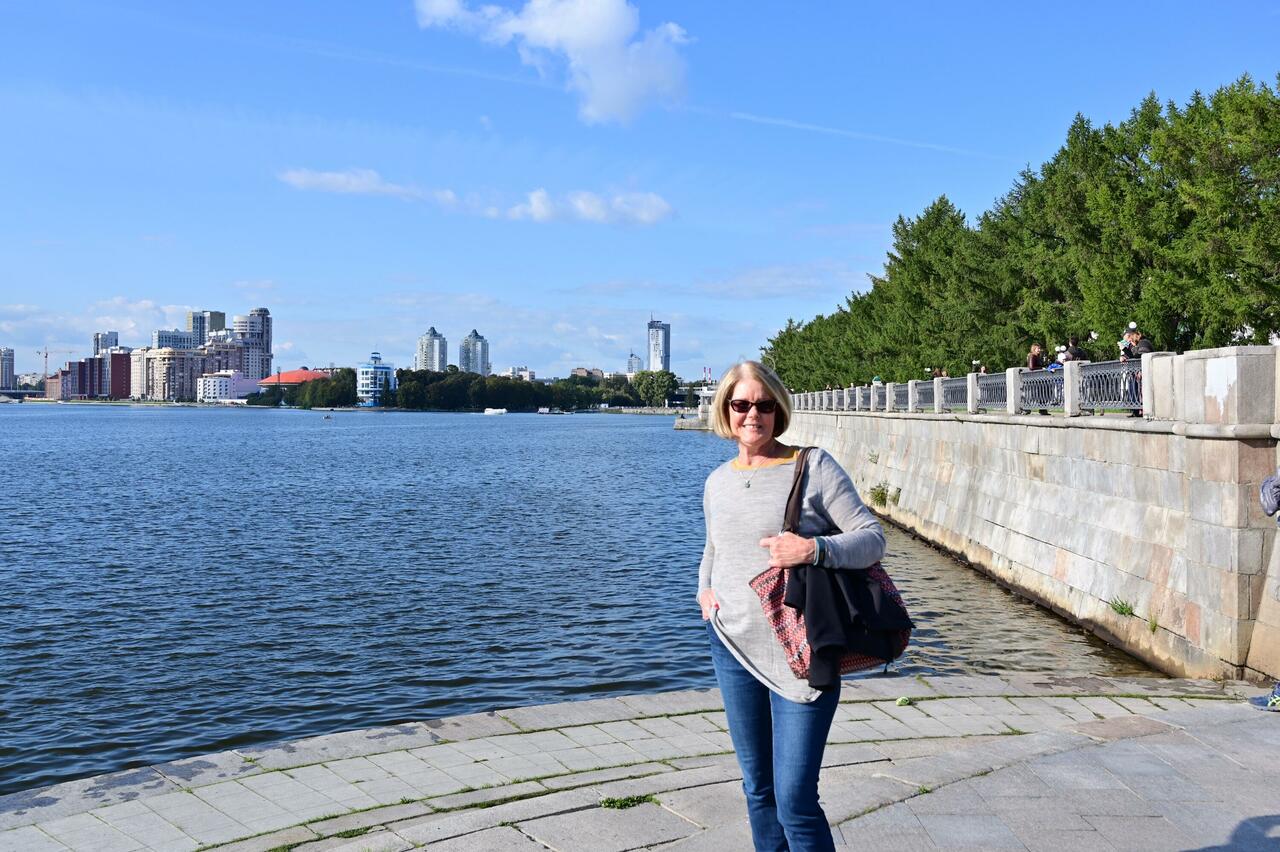
    We hopped on this train in Yekaterinburg, after a couple of days looking around. Yekaterinburg is a bit dour and dusty; the cars and in particular the 1960’s (or prior) buses, trolley buses and trams haven’t seen any soap and water for many a year.

    It is, however attractive around Istorichesky Skyver, the parkland around the expansive City Pond, and we enjoyed walking around, following a red line painted on the pavement joining the attractions.

    The handsome Church Upon the Blood marks the spot where the last of the Russian Royal Family - the Romanovs - were rather cruelly done in by the Bolsheviks, and the city was, of course, the birthplace of Boris Yeltsin.

    We rode up 52 floors to the viewing platform of the Vysotsky Tower, and enjoyed the views to all ends of the city from there, but in truth it was really just a big city without a lot to see.

    We checked out of the pleasant Marins Park Hotel, with their free laundry service, and wandered over to the station to catch our next train. Due to some flaw in the system the Brickwoods actually checked out with still-damp laundry, which they proceeded to hang all around their compartment Chinese laundry style.

    It was our third overnight train, so we were familiar with having people speak in Russian to us and send us on our way without knowing what on earth they were talking about or asking us to do.

    We had smuggled some wine and beer on board, but naturally this was gone pretty quick smart, so from then we had cause to use the dining car, and that was quite interesting.

    Not interesting for the food, perhaps, which would best be described as nourishing and rather bland (the sort you should have when sharing two toilets between 36 people, in fact) but eating out is all about the experience, after all.

    We walked in for lunch, and a waitress with a set of metal front teeth to rival Jaws from the James Bond films plonked down a couple of wrinkled old menus and stood with her pen poised.

    There was English on the menu, but it didn’t help really, as almost everything we pointed to she shook her head and said “Nyet”. For dinner we ordered three pork somethings and one chicken, and got two of each.

    We ordered a bottle of wine, which arrived sans glasses, and every time we ventured up to tell someone they shooed us away. Then when you picked up your glass to have a drink the carriage would get up such a shimmy shake that you nearly lost all of it anyway.

    At dinner time the dining car was a bit rowdy. It’s a requirement that you eat, so two funny young guys opposite were having a meal of potato crisps, washed down with endless beers to which they were adding some kind of mystery hooch. They were actually very friendly, if completely pissed, and we had a long and unintelligible conversation with them. They took one look at Don then used (probably) their only English word - Santa!

    In fact, a few other people used the expression Santa when we left the train. Despite being completely innocuous and keeping entirely to ourselves (as indeed did most of our fellow passengers) we (or at least Don) had apparently made an impression. We were even given gifts by some of them.

    At the next table were two older guys, already red eyed and staggering, settling down to lose a few more days with a freshly opened bottle of vodka.

    Kim and Sharon asked to have their photo taken with the provodnista, who had been exceptionally friendly the whole way and insisted on putting her whole uniform on for the photo.

    The scenery was amazing, particularly if you are partial to trees. Trees when you have lunch, trees when it gets dark, trees when you wake up. Trees when you wake up the following day. Winter comes early and hard so the leaves were already turning quite beautiful shades of yellow with the odd patch of red.

    We slept pretty well, and our accommodation was quite adequate, but we are still looking forward to our next stop in Irkutsk, where we will no doubt be swaying for a day or so until we regain our land legs.
    Okumaya devam et

  • Kazan

    7 Eylül 2019, Rusya ⋅ 🌙 11 °C

    Our first overnight train was an easy one - Moscow to Kazan, leaving at 11 PM and arriving just under 12 hours later. It was comfortable and we enjoyed the included breakfast - a hard, dark bun of some kind that even after tasting we weren’t sure if it was chocolate or dark bread, some juice and an entire family-sized block of dark chocolate each.

    We chose Kazan because as the capital of Tatarstan it has a lot of Islamic influence and we thought if we were going to look at a whole lot more churches on the trip we might as well look at some mosques as well.

    We went to the Kazan Kremlin, built on top of the highest point around and with high walls all around its 1.8 kilometre perimeter. It contained an interesting mix of museums (not that we visited any of them), the magnificent Kul Sharif Mosque and the Orthodox Cathedral of the Annunciation.

    Next to the cathedral was the Soyembika Tower - 58 metres tall and looking rather Pisa-ish with a pronounced lean.

    One museum we did visit was the quirky Soviet Lifestyle Museum. Its small collection contained patriotic toys and clothing and some appliances as well as a lot of pop memorabilia. There was a constant stream of fascinating pop clips playing - wooden performers, wooden audience looking scared to stop smiling and Eurovision circa 1960’s music.

    The lively and exciting Bauman Street runs from the Kremlin down to the scenic Kaban Lake and is full of bars and restaurants, buskers and other street performers. Think lots of people dressed up as horses and the like in a style best called early Hanna Barbera.

    We took a taxi out to the Temple of All Religions, an architectural mashup incorporating elements from all the major religions of the world - including, inside the building, retail. Conceived by a local artist of some repute, its construction is ongoing and it is an appropriate addition to a place where Moslems and Orthodox Christians live quite happily side by side.

    We caught bus number 45 for our return to the city, which was a pity as we should have caught bus number 2. Bus 45 began well, heading directly back to town but turned off and set out for the outer suburbs before we knew what was going on.

    Luckily, with the help of an old lady out to do her shopping, the young, friendly conductor (one lady even paid him her fare in apples) figured out enough of our gibberish to show us a stop near a metro station that would take us back to the city. To think that we may well have been the first Australians ever to catch the 45 bus!

    We finished off our very enjoyable two days with a walk around the Volga River foreshore, enjoying the views of the attractive Palace of Agriculture, before boarding the rather spartan train 378 for Yekaterinburg.
    Okumaya devam et

  • Moscow

    4 Eylül 2019, Rusya ⋅ ⛅ 16 °C

    Four days in Moscow and its surrounds has been barely enough to scrape the surface of this big and very definitely foreign city. But it was enough to see some fascinating sights and have a great time.

    The weather was fine and warm when we started our first full day with a trip out to VDNKh Park, an expansive playground for the citizens of Moscow to remind them of the wonders of the motherland. It was the last day before school went back and there were cadets - literally thousands of cadets - at some sort of function, with accompanying parents, siblings, teachers etc.

    The beautiful fountains, gardens and a pavilion dedicated to each of the former republics (including, superfluously, Finland) were quite nice, especially filled with Muscovite families enjoying a Sunday out. The cosmonaut pavilion, with some 1960’s space memorabilia outside (we didn’t go in) was interesting. It’s ironic really that the Americans now depend on Russian rockets to send a lot of their stuff up there!

    We looked in at the Cathedral of Christ the Saviour, made famous as the place where Pussy Riot were arrested, then visited a few of the quite beautiful Moscow Metro stations. The metro was an adventure in itself, but fortunately easy enough to work out.

    We then spent two days out of town, in Suzdal and Vladimir, two towns on Moscow’s “Golden Ring” and about 180 km away. Churches, monasteries, convents, more churches, a kremlin and in Suzdal’s case a picturesque river winding its way around all the above made for a great couple of days.

    Vladimir’s Cathedral of the Assumption, a riot of gold and portraits from top to bottom and the place where many of the Tsars were crowned, was fabulous, even with the usual sour attendants, souvenir sellers and beggars.

    Back in Moscow, we finished off our few days with a visit to The Kremlin and the Armoury Museum.

    Full of all sorts of things from wedding dresses to carriages to suits of armour, it was the gold and silver ornaments that were mind-boggling. From tea sets to jewel-encrusted gold bibles there were all sorts of things that a powerful ruler would expect to receive as a gift. The workmanship was astounding, the value of the collection incalculable.

    Then, having taken our snaps of St Basil’s Cathedral and Red Square, we took our leave of Moscow, the end of another stage of our trip.

    Tonight we hit the train to Kazan, as we begin to make our way across the country.
    Okumaya devam et

  • St Petersburg

    31 Ağustos 2019, Rusya ⋅ ☁️ 19 °C

    We are prepared for a more Russian Russsia as we get further into the country, but as an introduction St Petersburg has been brilliant, easy to get around, polite and friendly people and a host of the most amazing treasures and buildings we have ever seen.

    In fact, St Petersburg is perfect for a relaxing four or five night stay, which is rather a pity, as we only had three nights. However, we did our best and had some fun and experiences doing it.

    We caught the metro to our hotel, and in the process went as far underground as we have ever been. The escalators were so long they could have done with seats, and the actual train trip was but a small part of the experience.

    We joined about a thousand other tourists for an intimate wander through the Church of the Saviour on Spilled Blood, quite incredibly decorated from top to bottom with mosaics, all shades of blue and very beautiful.

    Then we immersed ourselves in the squeaks, rattles and confusion of the suburban train system and made our way 25 kilometres south to Pushkin, and the Catherine Palace, a monument to wealth and extravagance if ever there was one. It contains the Amber Room (beautiful - no photos allowed but plenty on the internet) which is completely lined with Baltic Amber and seems to glow red/orange/brown from every crevice.

    The story of the near-destruction of the palace during the siege of Leningrad, and its subsequent restoration, was well told through photos and quite moving.

    We caught a hydrofoil - a very impressive-looking vessel, like Sputnik with tail fins - out to the Peterhof, another shack in the country for the use of royalty and to infuriate the peasants a bit more.

    The gardens and the world’s most extensive set of fountains are what it is justifiably famous for, and we snapped away for a long time at the Great Cascade, all gold and spray leading from the palace down to the sea.

    Finally, late in the day and after the crowds had abated (you wouldn’t have thought so) we visited The Hermitage, with its huge collection of art in a stunning set of buildings on the riverfront.

    Some of the art was donated, some purchased and a lot acquired by the simple expedient of nationalising all the art in the country and taking it.

    It was a fascinating few hours (where a few days would be needed to take it all in, assuming you had the knowledge, patience and stamina).

    We have eaten a variety of (all non- Russian) meals at night, all around Nevsky Prospekt, the main shopping street, which absolutely buzzes in the evenings, with bands playing on street corners and a glimpse of light reflecting on a canal every few blocks. It really is a beautiful city.

    We are now on a Sapsan train en route to Moscow, where our holiday continues.
    Okumaya devam et

  • Helsinki - Via Manchester

    27 Ağustos 2019, Finlandiya ⋅ ☁️ 21 °C

    We caught the train from a warm and sunny Liverpool morning to a rather stifling Manchester afternoon, where we took a walk around.

    We went to Manchester Town Hall, a massive neo-gothic pile that will probably be worth a look through when it reopens in 2024. 2024 - that’s a big renno!

    Then came the John Rylands Library, another philanthropic gesture from an extremely rich mill owner’s wife.

    Actually, the library is a magnificent building, complete with a beautiful and incredibly atmospheric public reading room. Now part of the University of Manchester, it is still a free public reference library.

    A short flight a day later brought us to Helsinki, where we met up with Don and Kim and installed ourselves in an apartment for two nights.

    After a look around Senate Square, with the Cathedral dominant from high above and beautiful civic buildings all around, we then marvelled at the markets, all full of brightly coloured fresh produce and Finnish-looking souvenirs.

    We caught the ferry out to the Suomenlinna Island Fortress and wandered extensively around, enjoying the views and appreciating the fortifications and guns and stuff. It was built in 1748 by the Swedes and completely failed as a line of defence against the Russians, who the ran the place until 1918. Only then did Finland gain its independence.

    Then we did a tram trip out through the ‘burbs, stopping at Temppeliaukion, the Rock Church, hewn out of the bedrock and a very interesting and beautiful building. The copper and glass ceiling was quite incredible.

    Tomorrow morning we have shopping to do, as in the afternoon we enter Russia -the world of the Cyrillic alphabet - and won’t be able to read a single thing.

    Next post (hopefully) will be St Petersburg.
    Okumaya devam et

  • Liverpool

    24 Ağustos 2019, İngiltere ⋅ ⛅ 19 °C

    We caught the train from Edinburgh to Liverpool and installed ourselves near its very historic waterfront for three nights.

    From there we visited a few different places, each in some way related to the history of the city and the disproportionate contribution it has made to the modern world.

    The Beatles Experience proved to be a very interesting, if sanitised, telling of the Fab Four story, especially the early years in Liverpool itself. It was quite a feeling standing in an exact replica of the Cavern Club circa 1962. Too bad about 80% of the population wasn’t even born then.

    Liverpool the port proved to be a very pleasant place to wander around. The waterfront area was originally home to the trade in cotton and slaves then emigration and of course later the flow of materiel into Britain during World War Two. It was saved from redevelopment in the eighties and is realistically and faithfully preserved.

    We ate a couple of times on the Royal Albert Dock, steeped in history, and generally wandered the shoreline from Pier Head. The architecture was spectacular, befitting a pre-eminent port city and one with a UNESCO listing.

    Liverpool Cathedral was spectacular too, in a dark, square, brutal way. The UK’s largest, it was designed by Giles Gilbert Scott, whose eclectic body of work also includes the red telephone box.

    Finally, unable to resist the siren sound of Gerry and The Pacemakers any longer, we took a cruise on the Mersey Ferry and spent some time on the Wirral Peninsula opposite the city.

    Mersey Ferries, in a bizarre and maybe vengeful effort to diversify, bought a salvaged U-Boat - U534 - and sliced it up for display at their Woodhead Terminal. It was interesting peering into the rusted hulk and reading the history of the boat.

    Then we caught a train a few stops down to Bebington and visited Port Sunlight, a village built by William Lever to house the workers at his soap factory.

    By all accounts a humane and enlightened man - as well as a master soap marketer - he provided his employees with houses with separate bedrooms, plumbed-in baths and a toilet each, all otherwise rarities for working class people. Of course, he was also pretty much guaranteed his workers would turn up to work on time (and sober) as loss of their job also meant loss of their house.

    The Port Sunlight Museum was a small but informative hour or so, the preserved cottage next door very interesting and our walk through the local streets of a beautifully laid out and pleasant village was excellent.

    We did find the poor side of Liverpool wasn’t far from the surface, too. There were people sleeping rough all through the shopping precinct, and once away from the river it wasn’t quite so clean. There were quite a few beggars. Despite that, though, we thoroughly enjoyed this extremely interesting, attractive and historic city.
    Okumaya devam et

  • Edinburgh

    20 Ağustos 2019, İskoçya ⋅ 🌙 12 °C

    After what seemed like a lifetime of planning and last-minute organising of visas and ticket couriers we finally made our way to Edinburgh via Singapore and London.

    We caught the train up from London Kings Cross, detouring around the security-controlled queue of Harry Potter fans (“Potterphiles”? “Potteristas”? “Potties”?) waiting for their photo op at platform nine and three-quarters. What an absolute phenomenon those books are.

    The train was a good way to relax for the day after the long flight, although it was packed, with people sitting and standing in the vestibules.

    Even though we knew it was on, we hadn’t reckoned on the effect of the Fringe Festival, from the crowded train to the packed streets to the pop-up bars in Princes Street - it was an exciting place to be.

    Other than the street atmosphere we managed to see a few of the more traditional Edinburgh attractions.

    We caught the bus out to Leith and walked through the Royal Yacht Britannia, all spit, polish and tradition. The ship was quite tastefully done out in a manner suitable for the impressing of lesser dignitaries.

    Back in town and at the bottom of the Royal Mile we toured the palace of Holyroodhouse, all dark and hung with tapestries and harking back to an age where the lesser dignitaries were more easily impressed. It would have been a cold and depressing place to live, that’s for sure.

    That night brought us to the Edinburgh Military Tattoo, sitting up in the chilly grandstand with the magnificent backdrop of the castle in front of us.

    The show was great, a mix of tradition with modern elements. The images projected onto the castle walls were clever. The New Zealand military band that dropped their instruments mid-set and did a haka was out of left field.

    We climbed Calton Hill the following morning for some more views of the very hilly city, then in the afternoon caught the train out to South Queensferry and took a cruise on the Firth of Forth, under the bridges and out to Inchcolm Island.

    It was probably a very nice place, with its atmospheric ruined abbey and numerous fortifications, but in the cold, blustery wind and sporadic rain the returning boat, with its welcoming warmth (and on board bar) was what we really wanted.

    Today we move on to Liverpool, which will hopefully be just as much fun as Edinburgh has been.
    Okumaya devam et

  • Mystic Nagarkot

    9 Mart 2019, Nepal ⋅ ☀️ 16 °C

    Our final stop on this trip was Nagarkot, high up in the hills east of Kathmandu and with great views of the Himalayas - on the one or two days a year that are clear, it seems.

    But that was in the future as we boarded a Buddha Air ATR-72 for flight 101 - destination “Mountain”, a flight past Mount Everest. It was quite magical, not exactly reach-out-and-touch-it close but crystal clear in the early morning sunshine. No doubt that’s as close as we will ever come to the highest mountain in the world.

    Later in the morning we drove out of Kathmandu, stopped for some booze (these guides are easy to train once you get the hang of it) and drove to the Pashupatinath Temple, another complex of Hindu temples on the bank of the Bagmati River.

    This was another cremation experience, fascinating and unnerving at the same time.

    A cremation was commencing as we looked on from the other side of a narrow, poisonous looking river. This person was apparently well-known and had attracted quite a crowd, with spectators lining all the vantage points across the bridge and on both sides of the Bagmati.

    Just up the river another body was being prepared for the same destiny, feet being washed in the river and river water seemingly poured over the face. Some banknotes were left on the body as well.

    As this all took place life went on around it. A woman washed her hair under a tap in a far corner of the cremation area. People shopped and stickybeaked. Fake or real sadhus badgered us for money for a photo. Monkeys and dogs wandered around looking for scraps.

    It was the wails of a relative of one of the deceased that broke the spell for us. In all of our tourist-perving it was too easy to forget that these people were father or mother, son or daughter, loved and lover - real people whose death had caused real suffering.

    Back in the van and a little quietened, we drove on to Bhaktapur, a nearby township with another UNESCO Durbar Square.

    After lunch in another atmospheric rooftop restaurant - these seemingly breed like rabbits around medieval Nepalese squares - we took in the finer points of some carved pillars on the appropriately named Erotic Elephants Temple, copulating elephants (among other 1600’s erotica) being exactly what is depicted.

    Later in the afternoon we had an hour’s bone shaking drive up a rough track to Nagarkot and the Mystic Mountain Resort.

    It was certainly mystic, 2,100 metres up with the hills rolling away into the distance, and, somewhere beyond, the snow capped Himalayas. It was also certainly cold, quite a shock after the temperate weather we had enjoyed.

    We relaxed for a day, alternately cold or hot depending on the clouds that would regularly clear overhead but leave those elusive mountains invisible, reflecting on the incredible sights, experiences and fun and laughter that the last three weeks have brought us.

    Finally, at sunrise on our last day as we packed to leave, the sun rose to a clear day and we were treated to the magical reflections of the sun on the snow covered mountains, a fitting end to a great holiday.
    Okumaya devam et

  • Kathmandu - Land of the Living Goddess

    6 Mart 2019, Nepal ⋅ 🌙 13 °C

    Well, Kathmandu is now more than just an evocative name on a map for us.

    Having flown in from Delhi, the immediate contrasts were striking.

    It is a dusty city, but generally without rubbish everywhere (or cows, for that matter). Unlike most public areas in India it doesn’t smell like a public toilet. And, astoundingly, the locals get on with their business of driving like maniacs without using the horn. Kathmandu traffic is like watching a movie of Indian traffic with the sound turned down!

    We visited Patan Durbar Square, which the locals are still patiently reconstructing in places after the 2015 earthquake. The Royal Palace of the Malla Kings, dating from the 1600’s, occupies one side of the square and its courtyards were fascinating. The wood carvings were quite beautiful.

    The other side of the square is taken up with numerous temples and idols, seemingly randomly placed. We had earlier visited the Swayambhunath Stupa and found the same thing, only this time with monkeys and acres of cheap singing bowls for sale.

    We were lucky that our guide explained a bit about the bowls, and grateful that none of us had been tricked into buying a cheap, factory-made imitation.

    Actually, it was no wonder we were taken with the beauty of the Durbar Square, because earlier in the day we were each personally blessed by a Living Goddess.

    We ascended some narrow steps into a dingy room that smelt of mouse droppings, then a man carried the Goddess - the Kumari - in and sat her down on a kind of mini-throne. In turn we were able to pay some money, be daubed on the forehead with red powder by a four year old and take a snapshot of the scene.

    The Goddesses are selected from the Shakya caste and must meet strict physical, astrological and psychological requirements. Once they are chosen their feet are not permitted to touch the ground until their goddess-retirement.

    They remain a goddess until puberty, after which a new one is selected. It was in equal parts quaint, bizarre and - for the poor girl removed from the normal life of a child - extremely cruel.

    In the afternoon our guide took us on a fascinating walk through what must have been his local territory. One minute we were walking down a narrow alley off the market, next we ducked through a narrow, low doorway and emerged in a courtyard full of timber, derelict-looking buildings, with children kicking a ball around and dogs and chickens in equal numbers.

    There were small temples and idols scattered throughout the numerous alleys and courtyards that we walked though on this most interesting expedition.

    The capacity of the Kathmanduvians to find a way to make a living was illustrated by the number of tiny eating places in the narrowest of laneways all scattered through the area in which we walked. A couple of seats, a two-burner stove, a fridge and a dirt floor was all that was required.

    We seem to be rushing towards the end of our trip, and last night was the obligatory bad cultural show. This one had dancing - very well performed, if uninteresting - along with bad food, bad rice whiskey and no atmosphere whatever. Still, every trip has to have one!
    Okumaya devam et

  • "Steven! You need beer?"

    5 Mart 2019, Hindistan ⋅ ☀️ 20 °C

    Back in Delhi for a night before heading on to Kathmandu, here is the indulgence of a few general impressions.

    Firstly, a massive shout out to Anand, the driver who has patiently ferried us over a thousand kilometres of Indian highways and back roads.

    His rather stentorian voice would boom through the bus, “You need break?”, or more infamously the title quote above. He was at our disposal to go out in the evenings and was always ready with a great restaurant if we needed. Nothing was too much trouble, and he was quite unflappable.

    He was stopped by the police one time, and sprang out of the bus to talk to them. “Did you get a ticket?” we asked. “No,” he said, “I just paid them some money.”

    He would not only translate for us to buy drinks from some pretty dingy looking wine shops, he kept an esky in the bus topped up with ice so we could have a cold traveller in the afternoon.

    We could not overstate the difference having a private driver has made to our trip.

    Speaking of which, we spent a fair few hours on the road and grew quite used to the Indian traffic flow system. Slow trucks and fast cars share the right lane, no one moves over for anything, the horn is an always-on accessory and motor cycles, auto rickshaws, ox carts and the like make up the left lane of a multi lane road.

    Cows, of course, have right of way everywhere and may and do use any lane they please.

    The hard shoulder is reserved for slow vehicles, which could be travelling in either direction, plus pedestrians, pilgrims and roadside stalls.

    The trucks, mainly slow unarticulated Tatas or Ashok Leylands, all look overloaded and are decorated to within an inch of their lives, with black rope-like streamers attached to their mirrors, colour everywhere and a most unnecessary sign on the back - “Sound Horn”.

    The Indian government is working hard to sort out the traffic. For example, their speed hump technology is world class, and nothing speeds traffic better on a four lane highway than some random steel barriers across a lane or two.

    The poverty in India is in your face pretty much everywhere. You will see slums, people washing themselves in the street, people going to the toilet in the street. It is so common place that no one even seems to notice.

    And yes, India is in many ways filthy and polluted. The streets and even the country roads are lined with rubbish, the cities have amongst the world’s most dangerous air quality and there is a constant battle to preserve the monuments from the pollution.

    But despite all that we found it one of the most amazing destinations we have ever visited. Enormous cities full of wealth and monuments, Rajasthan outposts with their ubiquitous forts-on-a-hill and of course the incomparable Taj Mahal. Go if you get a chance!
    Okumaya devam et

  • Agra - Masterpiece in Marble

    4 Mart 2019, Hindistan ⋅ ☀️ 17 °C

    Well, we saved the best of India until the last, that’s for sure.

    We dropped into Fatehpur Sikri, a former capital of the Mughal empire founded in 1571. By some minor oversight they neglected to check whether there was a reliable water supply, however, so it was largely abandoned within 40 years.

    The remnants are built of beautiful red sandstone, and very cleverly designed to handle the extremes of weather, this being the hottest part of the country. Bedrooms were even designed to have a pool of water on the floor for cool in summer, and cascading water ran in living spaces to cool the breeze.

    From there it was a quick run into Agra and its enormous Fort. Built of the same red sandstone, with later rulers incorporating some of the white marble and design elements that make up the Taj Mahal, it seemed to almost glow as the setting sun hit the stone walls.

    There was a human element, too. Shah Jahan, builder of the Taj as a memorial to his wife (Mrs Jahan, also called Mumtaz Mahal) was not only responsible for the beauty of the Palace but also spent his last days imprisoned there after being deposed by his rather greedy if not despotic third son. His apartment, fittingly, looked over the Yamuna River toward the earthly masterpiece he had created.

    At six the next morning we were in the lobby, along with about a hundred other guests, to see the Taj Mahal at sunrise.

    This most perfect, most beautiful memorial to love, rose majestically from its slumber as the new day dawned, white marble seeming to change colour minute by minute in the growing sunlight.

    Well, maybe sometimes it’s like that. We stood around in thick fog less than fifty metres away from it and could not see a single thing!

    Our guide ran through his entire repertoire of interesting and moving stories of this incredible labour of love while we sat in the cold grey morning and waited.

    The faintest outline of the building was visible as we donned our shoe covers and ventured inside the mausoleum itself, where the happy couple rest for eternity.

    And it was inside that the incredible scale of this masterpiece became apparent. No painted designs for these people; twenty thousand artisans spent 13 years on the main building alone, with every pattern an inlaid work of art, from the floor to the ceiling. An artisan was almost guaranteed to lose a finger through grinding the precious stones, and his sight from the intricate detail of the work.

    As we emerged from the building, so too was it emerging ethereally from the mist, and the hordes all clamoured for the best vantage points.

    It was indeed crowded, but not so much so that we felt hemmed in. As we made our way though the grounds, still awestruck, it became obvious what a fitting final destination in India this was.
    Okumaya devam et

  • Jaipur - Fifty Shades of Pink-ish

    2 Mart 2019, Hindistan ⋅ ⛅ 19 °C

    The Palace of the Winds. Amer Fort. Jantar Mantar. Jaipur City Palace.

    Jaipur is oversupplied with majestic structures, any of which would make an Indian top ten list.

    But this doesn’t take into account the buzzing, noisy streets or the milk market, or the crowds or the inevitable squalor. More than anywhere since we left Delhi it is the whole package that makes up Jaipur.

    Painted a sort of terracotta-inspired pink in 1876 to impress the visiting and eccentric Prince Albert, the old town remains so today, although in a classic case of “do what I say” the Maharaja’s Palace didn’t get the same makeover and remains a cream blob in a sea of old strawberries.

    We drove to Amer Fort, about 11 kilometres out of town, and were bounced around in the back of a Jeep up to the entrance. What an industry the tourist-moving business is! There was a continuous convoy of jeeps ferrying people up the hill to be turfed out into an immense traffic jam from which the souvenir sellers could pick their marks.

    Then there were the elephants, hundreds of them conveying rather seasick-looking people up the hill by a less animal welfare-aware means of transport.

    The palace, with hilltop fortifications all around and towering over the township below, was spectacular, cleverly designed to defeat the extremes of heat by use of cascading water, and with some absolutely beautiful rooms and gardens. The Hall of Mirrors - Sheesh Mahal - was quite stunning.

    Back in town, we stopped for a photo of Jal Mahal - an eighteenth century palace built in the middle of Man Sagar Lake, with - inexplicably - four of its five storeys under water when the lake is at its highest. This was picturesque, but the tribe of small boys enjoying their exciting game of marbles by the side of the lake was a more privileged insight.

    Jantar Mantar is a kind of UNESCO listed outdoor observatory, replete with giant sundials and astrological detail. It was built by Maharaja Jai Singh, founder of Jaipur and, according to our rather proud guide, a man 25 per cent more intelligent than anyone else. Not quite sure how they measured that, actually.

    There were quite a few Indian tourists about, families and couple excitedly snapping away. One family even asked Sharon to be a part of their photographic record.

    Then we left Jantar Mantar, with its middle class Indian visitors, and went into the outside world, where we were confronted by small begging children, one of them carrying the inevitable semi-naked baby. They were appealing in a filthy, stinking way, but by no means underfed. The appalling life to which they looked destined was as moving as it was beyond our control.

    Oh, and it was also Sharon’s birthday. A lovely gift from Kim and Steve, a Happy Birthday singalong in the van and a nice Italian dinner in the nearby Taj Hotel made it one to remember.

    On the way back from dinner we were stopped at a level crossing while a long passenger train rumbled by in the dark, giving us a glimpse into another world - from the barely-occupied first class coaches to the jam packed fourth class. Plus the delay gave Aanand a chance a to gloat a bit more about the cricket as the Aussies headed for defeat in a one-dayer!
    Okumaya devam et

  • Udaipur on the Lake

    1 Mart 2019, Hindistan ⋅ ☀️ 23 °C

    We got off the beaten track a bit on the way here, driving from Jodhpur via the small town of Ranakpur and the incredible Rana Khumba Jain Temple.

    A symmetrical structure 60 by 62 metres, it contains 1,444 exquisitely carved marble pillars, no two of which are identical. It was well worth an hour’s bumping and jolting on narrow roads to reach it.

    We continued a steep, winding climb over the Aravalli range and on to Udaipur, but not before that darned Indian reality intruded into our world again.

    A crowd of onlookers, a wrecked motor cycle strewn across the road and the rider face down and unmoving in the middle of it. 137,000 people die here each year in road accidents, 25% of them motor cyclists. There were no jokes about the traffic or the drivers for the rest of the day after that most sobering of events.

    Famous for its lakes, Udaipur is an attractive city by Rajasthan standards. The lakes are low on water at present, and the rubbish-strewn shorelines not overly attractive, but overall we thought it excellent.

    We visited the Maharana’s Palace, large enough to contain two hotels plus his residence plus a museum and still have room left over to rent out for weddings and functions.

    It was very photogenic, perched on a cliff above Lake Pichola. The various preserved rooms were interesting and there seemed to be cool, green, peaceful courtyards everywhere. Then of course, from almost every window was an expansive view over the lake.

    We took a boat ride on the lake, cruising out to the Maharana’s “Fun” island. Exactly what kind of fun he used to take himself and his entourage off for wasn’t specified, but it was quite a small island.

    We visited the Garden of the Maidens, built by Maharana Sangram Singh in 1734 for his wife and entourage to relax. With fountains everywhere, manicured paths and gardens and bougainvillea running amok it was absolutely brilliant.

    For dinner one night our capable and friendly driver, Anand, took us to a restaurant on the lake. There’s not much view in the dark, mind you, and a cold wind came up that blew straight through us in our semi-outdoor location. These were minor considerations, though. Cold beer and wine, great food and an endless supply of inane conversation kept us well entertained.

    We also relaxed for a day here, sitting by the pool and wandering down for a look at our sister hotel - the uber-luxurious Oberoi. So pleased were the staff to see four Australians in thongs walking into their hotel that they gave us a ten minute tour then promptly called for a golf cart to take us back to where we had come from.
    Okumaya devam et

  • Jodhpur and the Jets

    26 Şubat 2019, Hindistan ⋅ ⛅ 24 °C

    From Jaisalmer to Jodhpur was an easy drive - if there is such a thing as an easy Indian drive - and a surprising transition.

    Jaisalmer has the atmosphere of a desert outpost - smaller, dusty and with its admittedly astounding fort built on top of a big pile of dirt.

    Jodhpur is a much bigger place and it too has a fort - the Mehrangarh Fort - which is extensive and built on a solid stone outcrop. It is called the “blue” city for the colours of the houses of the Brahmin caste, although blue houses weren’t all that numerous really.

    Outside the gate to the fort is a memorial to the soldiers lost when Jaisalmer and Jodhpur fought over the affections of the Princess of Udaipur. This would indeed seem to be a high price to pay to get a girlfriend.

    In the company of yet another knowledgeable and passionate guide we toured the Palace - also called the “Citadel of the Sun” - which towers over a hundred and twenty metres over the streets of the city. We saw depictions of the daily life of the Maharajas, depictions of battles, including elephants with swords and - just to confuse things - horses with fake elephant trunks attached to their heads.

    Jaswant Thada, the mausoleum of the Maharajas of Marwar, is close by the fort and another magnificent work of carved marble. We are trying so hard not to get blasé about these sights, any one of which is alone worth the effort of the trip.

    On another level again was the Clocktower, Ghanta Ghar, in the middle of one of the noisiest, most chaotic markets we have seen. The was clothing or fabric on sale in one location that had the frenzied locals climbing over themselves to get hold of some.

    We stayed at the poshly-named Balsamand Lake Palace Hotel, and it was quite special.

    The hotel rooms are cleverly built into the arches under an aqueduct that formerly led water from Balsamand Lake. The grounds are perfectly manicured and are home to peacocks, monkeys and other wildlife. The dam that holds back the lake, dating from 1159, is an architectural monument in its own right, although the aforementioned monkeys seemed to regard it as their private domain and weren’t exactly welcoming toward us.

    We had drinks in the grounds, in the peace of the late afternoon and accompanied by the odd peacock, then a delicious and fun dinner on the lawn, warmed by braziers of burning timber and eating under flickering candlelight.

    That night however, some were awakened by the roar of fighter jets overhead. India and Pakistan, not exactly best buddies, were having a tit for tat shooting match after the murder of some Indian soldiers in Kashmir by Pakistani terrorists. We were only 250 kilometres from Pakistan.

    It is a privilege to see all these beautiful and exciting places, but occasionally there is a reminder that the troubles of the world may also be closer than we would want.

    The following morning, though, normal transmission resumed. We were served breakfast each morning by the oldest group of waiters we have ever come across, all handlebar moustaches and ramrod straight posture, for whom nothing was too much trouble and all seemed normal in the world once again.

    Next stop Udaipur; the adventure continues.
    Okumaya devam et

  • Jaisalmer Desert Frolic

    23 Şubat 2019, Hindistan ⋅ ☁️ 22 °C

    We left Delhi’s chaotic six lane freeways, usually with vehicles ten across, and flew into Jaisalmer, where the road to the airport is a single lane only.

    There was no one there to meet us. Steve had his phone stolen, either from the taxi or the hotel. Off to a great start to our Rajasthan sector.

    Then we bought some beer and wine to take up to a sunset viewing area only to find we weren’t allowed to bring it onto the property - things were getting better and better, and the sunset wasn’t all that flash anyway.

    So we drank our beers and our wine - from plastic cups - in our ten seater bus and generally tried to put the day behind us.

    Jaisalmer celebrates the Desert Festival each February with signature events such as turban tieing contests and a tug of war. They also select their finest example of manhood to be crowned Mr Desert, and we had the absolute honour of being shown around the city by Vijay, Mr Desert 2013! At least, that’s how big a deal he made it out to be when he was telling us.

    He was also a teacher, an actor and, in his world at least, a movie star. He proudly showed us the photos of his 2013 victory that were still on display throughout the Jaisalmer Fort.

    Actually, Vijay was more into promoting his beloved Desert Festival than promoting himself, and he was a great guide, knowledgeable, easy to understand and personable.

    He took us to the Lake, built by the wife of the King for water storage and typical of peaceful Indian lakes. This means the shore was covered in rubbish and we seemed to spend a lot of time dodging vendors, cows and lactating dogs.

    We then walked up into the fort, built on a large hill and very imposing in the relatively flat country of the Thar Desert. We visited a Jain Temple and were astonished at the quality and detail of the stonework.

    We visited a coffee shop perched right on the very top of the wall of the fort, reached by a step set of stairs that the owner somehow climbs all day without spilling a drop.

    We visited a haveli, an old residence in the heart of the fort, which former prime minister Mrs Ghandi thought so photogenic she had some buildings knocked down opposite so as to give a better view.

    Late in the afternoon some of the intrepid travellers drove out to the Sam Sand Dunes for a spot of camel riding, an enjoyable pastime for all, except maybe the camels!

    Jaisalmer was smaller and dirtier than we expected; next we head back east to Jodhpur and, we assume, more civilisation.
    Okumaya devam et

  • Delhi in 24 Hours

    21 Şubat 2019, Hindistan ⋅ 🌫 16 °C

    Changes in our flights, and the Delhi traffic, meant that it was quite a rush. It was evening before we arrived, so we had only one full day to take in the sights, sounds (and, being India, smells) and atmosphere of a capital city of over 25 million people.

    We kicked off our tour of the city in Old Delhi, where we visited the Jama Masjid mosque, one of India’s largest and built by Shah Jahan of Taj Mahal fame. It was certainly extensive, and a complete contrast to the chaos in the old city outside.

    Then we immersed ourselves completely in the chaos on a rickshaw ride through the bedlam of the alleys of Chandni Chowk, the old market place.

    It was an exciting blur, as we weaved our way around, dodging carts loaded with just about anything, as well as people, cows and even a few monkeys. From time to time the driver would yell over his shoulder “Sari market” or “Spice market” or “Stationery market” but half the time we were too busy holding on and looking around to hear him properly.

    The afternoon was great, too. Among the highlights:

    Qutub Minar is a quite beautiful 73 metre high tower built in 1192 and in the midst of a number of other Islamic structures.

    Humayun’s Tomb was built for King Humayun by his grieving wife in 1570, and was the inspiration for the Taj Mahal. It also now houses Mrs Humayun and an assortment of other, lesser, Humayuns.

    For dinner we went to a restaurant called Indian Accent, one of Delhi’s finest, and for which we are grateful to Mike and Myra Smith for the recommendation and Steve for persevering with the booking process.

    It was, quite simply, the best Indian food we have ever had, and so unlike the typical suburban rogan josh we are used to it is a pity to call it by the same name!

    Our wonderful dinner over, we were straight off to bed as we were leaving for the airport at 5:30 am.

    Next, onward to Jaisalmer.
    Okumaya devam et

  • Varanasi - Another World

    20 Şubat 2019, Hindistan ⋅ ☀️ 27 °C

    Well, if Mumbai is a city of contrasts then Varanasi is on the moon!

    No famous buildings to speak of, and no nightlife for westerners, it is all about the atmosphere and the incredible spirituality of the Hindus for whom it is the most important place in the world.

    Our introduction to the Varanasi cremation business was on the way in from the airport, where we passed a beaten up minivan with a body tied to the roof, trussed up with coloured cloth like a Christmas present and en route to one of the cremation ghats.

    In the evening of our first day we visited an Aarti Ceremony on the banks of the Ganges, and never was the old saying “getting there is half the fun” more true.

    We were in an auto rickshaw, the traffic too thick and the roads too narrow for a normal van. We were pummelled, deafened and alarmed in turn as we wove our way through narrow, filthy, congested alleyways on the way to the river.

    Then the pummelling auto rickshaw began to look quite attractive when we were forced to walk the last half kilometre or so. More than once we were forced to all hold hands to form a chain to cross roads filled with people intent on our demise. The locals seem to walk through the thickest traffic on the narrowest streets with impunity, but it was a very long walk for we white people.

    And the crowds! After the Aarti Ceremony some twenty thousand were expected to go to the temple, and the queue was already some kilometres long.

    The ceremony itself was colourful and incredibly atmospheric, with seven stages set up on the ghat and large crowds sitting on the ground in front of them and also crammed into boats moored in the river.

    Then of course we had a repeat dose of terrifying, kidney-bruising transport on the way back.

    The next morning we were back down at the river by 7:00 to take in the early morning bathing, and the early morning cremations.

    The ghats of Varanasi are amazingly picturesque, especially in the early morning light, and it was very peaceful as we were rowed some kilometres along the shore.

    We disembarked and walked up through narrow streets, past cows and beggars and dogs, dodging carts loaded with firewood (360 kilos per cremation, we were told) that threatened to run out of control down the hill at any time.

    A lot of this we took in rather slowly, as we spent a lot of time looking at the ground, dodging a plethora of different species and styles of faeces.

    Back on the river, we saw numerous cremations taking place, not with any whaling or carry on, just small groups of people near the fires doing what their custom and religion dictated.

    We were moved by the quiet devotion of the Hindus in relation to the activities on the bank of “Mother Ganga”. It’s every Hindu’s wish to die in Varanasi and be cremated and his ashes scattered in the Ganges, as this frees them from the cycle of death and rebirth (and, I suppose, the risk that in the next life they would come back as a mosquito or something).

    Next stop Delhi.
    Okumaya devam et

  • Mumbai - City of Contrasts - and Smog

    18 Şubat 2019, Hindistan ⋅ ☀️ 28 °C

    We have just finished two exciting days in Mumbai, seeing the sights and, with some expat help, getting just a little bit off the beaten tourist track.

    It is certainly a city of contrasts. Designer boutiques and upmarket restaurants sit alongside street food sellers. Autorickshaws fight with Jaguars and Maseratis for a share of the road. We saw multi, multi-million dollar houses just a block away from the most appalling looking slums. Security is everywhere, bags are x-rayed at hotels yet motorcycle helmets are apparently optional and seatbelts are only compulsory in the front seat of a car.

    And it is certainly polluted, with brown smog ever present, although as India first timers we aren’t yet smog experts.

    On the tourist front, we took a (long) boat ride to Elephanta Island, then a (long) walk up the hill to the eponymous cave, dodging cows and palanquins, monkeys and sleeping dogs. A Hindu Temple, it was full of carvings of various Vishnus and Shivas and Ramas. Our guide gave an informed and passionate commentary about the detail in the panels, most of which went over our heads.

    We looked in at Dhobi Ghat, an absolutely enormous outdoor laundry washing by hand some thousands of bedsheets and other clothing each day. We took a quick snap of the Victoria Terminus railway station and walked briefly through the Hanging Gardens.

    Ghandi’s residence - part museum, part memorial, part library - was interesting and rather moving, the tumultuous recent history of India and his part in it quite well depicted.

    We met Steve’s mate John, and a fellow expat called Anil, for a great dinner then spent the following day with them, looking at some of the construction projects they had been involved in and generally exploring to the north of the city.

    For dinner, back near our digs, we went to Cafe Mondegar, very atmospheric and with a largely local clientele. The food and drink was delicious and inexpensive (and, as of the time of writing, safe and hygienic).

    We were very lucky to have stayed in the Taj Mahal Palace Hotel, on the water right next to the Gateway of India and in the news in2008 when it was attacked by terrorists. It was great to take in the atmosphere of this grand old building and pretend for a few days that we could afford to do it all the time.

    Today we move on to Varanasi and a new chapter begins.
    Okumaya devam et

  • Sunny (and windy, and rainy) Sorrento

    16 Şubat 2018, Avustralya ⋅ ⛅ 20 °C

    From Daylesford we popped down to Port Fairy for four nights, for the Port Fairy Jazz Festival as well as a nice town with some great coastal scenery.

    Playing and listening to the Jazz was enjoyable as always and our accommodation was terrific and close to town to boot.

    We left Port Fairy on Monday (11th Feb) and took a leisurely drive through Camperdown, Colac and Geelong to Queenscliff and the ferry across Port Phillip Bay to Sorrento. Typical of so many towns in country Victoria all these had their share of history, scenery and interesting and stylish architecture.

    Sorrento, once we had recovered from the bill shock, was great too, and we explored quite a bit of the peninsula.

    Portsea Pub was great to visit for a morning lemonade (no, really) and an evening meal, with possibly the best outlook of any hotel Australia.

    We spent a warm, calm and sunny evening on the beach at Mount Martha, in front of our friend Graham’s boatshed eating fish and chips and alternatively watching an incredible sunset and a bush rat that befriended us.

    We were nearly blown away by winds at the Cape Schank Lighthouse on a wet and cold afternoon, then the following day had a great drive up the coast to Mornington (with a seemingly endless shopping strip and every eatery and boutique on the planet) before going to the Peninsula Jazz Club’s Friday night concert.

    The Royal Garden Jazz Band were, as always, brilliant, the average audience member, as always, a bit decrepit.

    So we’re now heading home, via a side trip to Healesville and a night in Albury. This has been a great holiday, with fantastic company, fascinating places to visit and far too many pizzas, cakes, Pub dinners and cafe breakfasts.

    Now back to reality.
    Okumaya devam et

  • Downtown Daylesford

    7 Şubat 2018, Avustralya ⋅ ⛅ 33 °C

    Fourth stop on a road trip around Victoria.

    We overnighted in Queanbeyan before meeting our friends the Claytons and driving down to Metung - a most picturesque little village on the Gippsland Lakes, via lunch in Mallacoota. Metung, surrounded on three sides by the Gippsland Lakes and with a great waterfront pub, was a perfect start to the trip.

    From Metung we explored the Lakes area, taking in the brewery at Bruthen and some scraggly koalas on Raymond Island.

    Then we left the coast and did the spectacular drive through Omeo up over the range through Dinner Plain and Mount Hotham and back down the roller coaster to Bright - leafy, pleasant and beautifully situated on the Ovens River.

    A single night in Bright and an easy day on the road finally brought us to Daylesford, where we have based ourselves for two days.

    We have explored the very pleasant township, positively flayed ourselves with bric a brac markets, taken in the gardens and the lake and had a great pizza for dinner with live piano music setting the atmosphere.

    Next stop will be Port Fairy, and some jazz.
    Okumaya devam et

  • Athens - Not just ruins

    14 Ekim 2017, Yunanistan ⋅ ☀️ 23 °C

    As we left the fun and beauty of Santorini we were a bit uncertain about Athens. A bit poor and seedy? Lots of beggars and ATM's without cash?

    Well, actually no. From start to finish we enjoyed every aspect of Athens, from the archaeological sites to the shopping to the restaurants to the gardens.

    We stayed at the La Strada Hotel, special enough to get a couple of photos below, one for its great rooftop bar with an Acropolis view, and one for the room, apparently designed by a guy who owns a glass factory!

    We visited all the ancient sites, plus the Acropolis Museum and the National Archaeological Museum. These latter two were great to help make sense of the ruins, some of them not more than piles of rock to our untrained eyes.

    How the restorers can reinstate a piece of pottery broken into twenty pieces, then strewn all over the ground, then buried for a couple of thousand years is incredible.

    Monastiraki and its stalls and bars and restaurants was great fun too. We quite enjoyed having a drink and a wander around in the evening, when the hordes of cruise passengers had all retreated back to the buffet.

    Well, by the time anyone reads this we will be back in Arncliffe, recovering and unpacking and ready to go again. What a great holiday!
    Okumaya devam et

  • Santorini - rather nice

    9 Ekim 2017, Yunanistan ⋅ ☀️ 20 °C

    We left a wet and miserable Malta and two short flights later arrived in paradise!

    Well, paradise for a few days, that is. We stayed in Fira at the slightly retro (but I don't think they mean to be) Hotel Atlantis, where the exact same breakfast is served everyday by a waiter who diligently recites the name of every dish as he puts it down on the table. On the plus side, though, the pool is very nice - although it was a bit cool when we were there - and the views are stunning.

    We were happy to kick back after three weeks of crazy busy sightseeing in Italy and Malta, but we did manage to see a few things.

    We walked down to the old port, dodging donkeys and their faeces and lots of cruise ship passengers, and had a delicious but simple lunch sitting right on the very edge of the wharf.

    We walked the ten or so kilometres to Oia, a more ambitious adventure but great fun also. It was a great mix of scenery, from the various luxury accommodations of Imerovigli and Oia to the barren and spectacular views over the caldera to the occasional whitewashed church. It was quite a lot of trudging up and down hills to get there, though.

    The weather has also been a bit iffy, quite windy and not as hot as we expected even allowing that it is late in the season.

    We've also had some terrific meals and have loved the atmosphere of this relaxed town with its incredible location.

    Well, R and R over, we've watched our last caldera sunset and are now en route to Athens to resume exploring. One more destination and this year's holiday comes to a close.
    Okumaya devam et

  • Malta - The Another Bloody Fort Tour

    5 Ekim 2017, Malta ⋅ 🌧 15 °C

    Malta - so many superlatives, so few paragraphs!

    We have stayed for a week in Haz-Zebbug, a village in the interior of the island well known for... well, not its tourism industry. We would walk through town on the way to the bus stop each morning and be stared at as if the Martians had landed, although maybe that was due to the number of slabs of beer we bought from the local convenience store (the owner has now retired and is living in Monaco).

    Our villa, though, accommodating all thirteen of us, was excellent, a labyrinth of bedrooms, sitting rooms, kitchens and stone spiral staircases leading up to the roof and down to basements unknown. All in all it was a good fun base from which to terrorise the locals and explore the island.

    Valletta has a beautiful setting on a peninsula with a harbour on each side, incredible fortifications all round, attractive buildings and enough souvenir shops to drive the economy of a small city. It also has so much history it just about oozes out of the stonework, from the bloodthirsty knights of the 16th century to the incredible hardships of World War 2.

    We got out of the capital a bit too, visiting the old capital of Mdina (yet another fortress), the 200 metre high Dingli Cliffs, the Island of Gozo (yet another fortress) among others.

    Probably the best thing about Malta, though, was the chance to share this adventure, and the odd Cisk beer and Aperol Spritz, with such good, warm and funny friends.
    Okumaya devam et

Kendi seyahat profilinize kavuşun

Ücretsiz

QR code

iOS için FindPenguinsAndroid için FindPenguins