• NattyE
  • Craig Maude
  • NattyE
  • Craig Maude

Morocco

NattyE & Craig tarafından 87 günlük bir macera Okumaya devam et
  • Tazantoute

    15 Şubat 2024, Fas ⋅ ☀️ 22 °C
  • Heading to the Desert (Merzouga)

    17 Şubat 2024, Fas ⋅ ☀️ 21 °C
  • Cycle Ride in the Desert

    19 Şubat 2024, Fas ⋅ ☀️ 21 °C
  • Ziz Valley

    20 Şubat 2024, Fas ⋅ ☀️ 15 °C

    Snaking down through the dramatic Ziz Gorges from Rich, the Oued (River) Ziz brings to life the last southern valley of the Ziz and the Tafilalt oases before puttering out in the rose gold dunes of Merzouga. Starting just south of the Middle Atlas town of Rich and about 30km north of Errachidia, the tremendous Ziz Gorges provide a rocky passage south through the Tunnel du Légionnaire (built by the French in 1928). To the south, the valley widens, presenting a spectacular sight: a dense canopy of palms wedged between ancient striated cliffs, which date to the Jurassic period. It's worth taking some time here to explore the rich, untouristed palmeraies (palm groves).Okumaya devam et

  • Leaving Meknes & Azrou

    21 Şubat 2024, Fas ⋅ ☀️ 23 °C

    Quick visit to Meknes and drove past Azrou

    Meknes (Arabic: مكناس, romanized: maknās, pronounced [maknaːs]) is one of the four Imperial cities of Morocco, located in northern central Morocco and the sixth largest city by population in the kingdom. Founded in the 11th century by the Almoravids as a military settlement, Meknes became the capital of Morocco during the reign of Sultan Ismail Ibn Sharif (1672–1727), son of the founder of the Alaouite dynasty. Sultan Ismail created a massive imperial palace complex and endowed the city with extensive fortifications and monumental gates.[7] The city recorded a population of 632,079 in the 2014 Moroccan census.[6] It is the seat of Meknès Prefecture and an important economic hub in the region of Fès-Meknès.Okumaya devam et

  • Volubilis

    22 Şubat 2024, Fas ⋅ ☁️ 21 °C

    lready a thriving town, the Romans developed Volubilis from approximately 25 BC, during the reign of Juba II, a Berber prince appointed as the ruler of the region by the Emperor Augustus. Juba II was married to the daughter of Anthony and Cleopatra.

    The residents of Volubilis were a diverse people and included Africans, Syrians, Spaniards and Jews, amongst others and would have numbered up to 20,000 at its peak.

    Development continued to 40 AD, when Volubilis became a minicipium (a self-governing Roman city) of the Roman African region of Mauretania Tingitana. The fortifications of Volubilis were erected in approximately 168 AD, during the rule of Emperor Marcus Aurelius Antoninus, known as Caracalla.

    Amongst the ruins of Volubilis, visitors can see an array of public buildings, olive mills (the economic basis of ancient Volubilis), sophisticated thermal baths, houses, temples and defensive walls with many elaborate mosaics dotted throughout.

    One of the most famous structures at Volubilis is the Triumphal Arch of Caracalla, built for the Roman Emperor upon his death in 217 AD. The Triumphal Arch of Caracalla is very well preserved, and although its top section is now gone, it is still an incredibly impressive structure and a treat for any history enthusiast. Climb the hillock next to it for impressive views of the site.

    By no means has the whole site been excavated – roughly 20 hectares have been uncovered, mainly at the northern end. There’s a small onsite museum with some of the finds made at Volubilis, but the bulk of them remain at the National Archaeology Museum in Rabat.
    Okumaya devam et

  • Chefchaouen

    23 Şubat 2024, Fas ⋅ ☁️ 12 °C

    Built on a mountainside, Chefchaouen is a city with a special vibes. It unique charm gives an impression of unreality. With its blue-rinsed houses, the whole city seems to be bathed in azure. You walk around as if you were in a dream.

    More than just an ornament, the beautiful Chefchaouen brims with attractions. Its heritage is rich. The inescapable Medina with its famous narrow winding alleys, is an opportunity to mingle with the local population, and to smell and taste delights: from freshly baked bread, to skillfully prepared tagines. There is also the Kasbah which stands in the middle of the old quarter: its lush gardens, located in the center of the city, are a haven of freshness. Its museum which is home to a collection of old weapons, some photos of the city, and textiles.

    Boasting its unique geographical position, Chefchaouen is a paradise for walkers. The paths of the surrounding mountains offer pleasant hiking activities. You’ll explore a new side of Morocco, that of the Rif mountain range.

    Make the most of your stay in the picture perfect Blue city !
    Okumaya devam et

  • Akchour

    24 Şubat 2024, Fas ⋅ 🌬 17 °C

    Akchour waterfalls are located in the heart of Rif Mountains. You will find this waterfall cozily nestled in the small town of Akchour and surrounded by diverse flora and fauna. These cascades of Akchour stand proud in the Talasssemtane National Park. The two main waterfalls are connected by a bridge called God’s Bridge.Okumaya devam et

  • Castillo Colomares

    1 Mart 2024, Ispanya ⋅ ☀️ 14 °C

    Castillo de Colomares is a monument, in the form of a castle, dedicated to the life and adventures of Christopher Columbus. It was built near Benalmádena in Spain, between 1987 and 1994.[2] Covering an area of 1,500 meters, it is the largest monument in the world to the explorer, but also contains the smallest church in the world, covering an area of just 1.96 square meters. In 1987, Dr. D. Esteban Martín Martín began this singular work in an improvised way and with the help of two masons he created Colomares in seven years of artisanal work using brick, stone and cement. Thanks to his knowledge of art, history and architecture, Dr. Martín was able to mold this work at his whim, turning it into a "unicum" due to the stony way of narrating the Discovery of America.

    Benalmádena stupa

    The Benalmádena stupa was designed to be the largest Buddhist stupa in the western world. The story behind the stupa goes back to 1990 when a Buddhist master came to Spain to give talks to the faithful in Vélez-Málaga. In Vélez, there is a Buddhist meditation centre.

    Four years later, Lopon Tsechu Rinpoche decided to return to Spain and build a stupa in Vélez Málaga, where he had given his talks. His idea was to give the area a monument that would symbolize peace and prosperity for Spain.
    Okumaya devam et

  • Antequera Walkabout

    1 Mart 2024, Ispanya ⋅ ☀️ 14 °C

    Antequera is a city of great cultural and economic richness. Its historic centre is made up of more than fifty monuments and buildings, some of which date back to the Bronze Age, such as the dolmens of the Menga Cave, Viera and Romeral.

    In its historic centre, crowned by the castle and the Basilica of Santa María, there is a succession of collegiate churches, churches, convents, palaces, arches, gates, hermitages, stately houses, and even an "alcazaba" or casbah. Of particular note are the eighteenth-century Nájera Palace, which now houses the Municipal Museum, the Catalinas Convent and the Palace of the Marquises de la Peña, in Mudéjar and Renaissance style. A visit to the natural site of El Torcal, in the surrounding area, is highly recommended.
    Okumaya devam et

  • Dolmens of Antequera

    2 Mart 2024, Ispanya ⋅ ⛅ 10 °C

    The dolmens of Antequera are a group of three megalithic structures located near the town of Antequera in the province of Malaga, Spain. The dolmens, which date back to the Neolithic period, were constructed between 3000 and 2500 BC and were used for burial purposes.

    The three dolmens are known as the Menga Dolmen, the Viera Dolmen, and the El Romeral Dolmen. The Menga Dolmen is the largest of the three, measuring 27 meters in length and consisting of 32 upright stones supporting a massive capstone weighing over 180 tons. The Viera Dolmen is slightly smaller, but still impressive, measuring 21 meters in length and featuring a similar arrangement of upright stones and a large capstone. The El Romeral Dolmen is smaller still, but notable for its intricate carvings and decorations.
    Okumaya devam et

  • Alcazaba of Antequera

    2 Mart 2024, Ispanya ⋅ ☁️ 13 °C

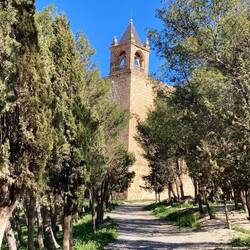
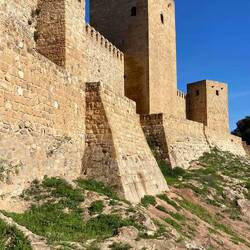
    The Alcazaba of Antequera is a Moorish fortress in Antequera, Spain. It was erected over Roman ruins in the 14th century to counter the Christian advance from the north. The fortress is rectangular in shape, with two towers. Its keep (Spanish: Torre del homenaje, 15th century) is considered amongst the largest of al-Andalus, with the exception of the Comares Tower of the Alhambra. It is surmounted by a Catholic bell tower/chapel (Templete del Papabellotas) added in 1582.Okumaya devam et

  • Driving Through the Sierra Nevada

    3 Mart 2024, Ispanya ⋅ 🌬 14 °C

    Sierra Nevada (Spanish meaning "snow-covered mountain range") is a mountain range in the Andalusian province of Granada in Spain. It contains the highest point of continental Spain - Mulhacén, at 3,479 metres (11,414 ft) above sea level.

    It is a popular tourist destination, as its high peaks make skiing possible in one of Europe's most southerly ski resorts, in an area along the Mediterranean Sea predominantly known for its high temperatures and abundant sunshine. At its foothills is found the city of Granada, and a little further south, Almería and Motril.

    Parts of the range have been included in the Sierra Nevada National Park. The range has also been declared a biosphere reserve. The Sierra Nevada Observatory, the Calar Alto Observatory, and the IRAM 30m telescope are located on the northern slopes at an elevation of 2,800 metres (9,200 ft).

    The Highest Peak of Sierra Nevada is Mulhacén at 3,479m, followed by Veleta at 3,398m and Alcazaba at 3,371m.
    Okumaya devam et

  • Gezinin sonu
    9 Mart 2024