• Jane Rider
  • Jane Rider

World cruise

Janeによる136日間のアドベンチャー もっと詳しく
  • Sea day

    2024年4月12日, South Atlantic Ocean ⋅ 🌬 17 °C

    We were able to leave Cape Town about midnight so we are now heading toward Namibia. The sea has been a bit rough since we are at the intersection of the Agulhas and the Benguela currents. Due to the delay in Cape Town we will not be able to go to Luderitz but will stop at Walvis Bay, Namibia.

    The animal for the day is the.springbok, an antelope fouund in south and southwest Africa. They have the peculiar habit of pronking, in which the springbok performs multiple leaps into the air, up to 2 m (6.6 ft) above the ground, in a stiff-legged posture, with the back bowed and the white flap lifted. Primarily a browser, the springbok feeds on shrubs and succulents; this antelope can live without drinking water for years, meeting its requirements through eating succulent vegetation.
    もっと詳しく

  • Walvis Bay, Namibia

    2024年4月13日, ナミビア ⋅ 🌫 18 °C

    Because of delays in Cape Town our shore time in Walvis Bay has been shortened and none of the planned tours could be done. The staff scrambled and put together a tour to the Valley of the Moon in the national park.

    Namibia (population 2.5 million) was carved out of South Africa and is basically desert (it is the driest country in South Africa) but a desert with diamonds. Other products are agriculture, tourism, uranium, gold and silver. Unemployment is 52%. "It is one of the most free and democratic countries in Africa, with a government that maintains and protects human rights and freedoms. However, significant issues include government corruption, policy inertia and prison overcrowding." from wikipedia.

    Anyway, our tour was to the Valley of the Moon was delightful. On the way we saw a colony of Greater Flamingos. We all gathered around Namibian dancers, drinks and snacks admiring the desert valley, listening to music and watching the sunset. Fun for all!
    もっと詳しく

  • Wildebeasts and Giraffes

    2024年4月14日, South Atlantic Ocean ⋅ ☁️ 19 °C

    Moving north up the coast of Africa. So pictures of wildebeasts and giraffes from the Safaris is todays topic.

    Wildebeasts are in the same family as antelope. There are 2 species--blue wildebeasts and black wildebeasts. I think my pictures are of the blue wildebeast.

    There are about 95,00 giraffes in the wild so they are considered vulnerable. Their range is scattered from Chad in the north to South Africa in the south. There are 9 subspecies. Giraffes are considered
    もっと詳しく

  • Null Island

    2024年4月17日, スペイン ⋅ ☀️ 19 °C

    Today we visited Null Island. Never heard of it? Well, it doesn't exist. It was created to describe the intersection of latitude 0 and longitude 0. There is a buoy, called Soul Bouy, placed there in 2009. The previous buoy disappeared in 2008 and the current one hasn't been seen in months and hasn't sent weather data in 2 months. It is part of the PIRATA system, a set of 17 buoys installed in the tropical Atlantic Ocean since 1997 by the United States, France, and Brazil to measure weather data. Like the other buoys in the system, it is named after a musical genre.

    Our ship did a repeated one mile circle around where it should be looking for it to no avail, but because we crossed 0,0 we have been inducted into the Order of the Emerald Shellback.
    もっと詳しく

  • Lion and rhinos

    2024年4月18日, ニジェール ⋅ ☀️ 42 °C

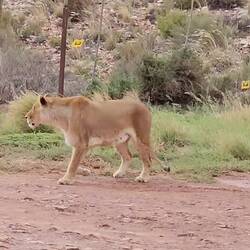
    At Aquila Game Reserve the lions are separated from the other animals so we drove into the section reserved for them and immediately saw 2 lionesses and a large male lion. African lions are vulnerable because their population has decreased by 40 per cent since the 1990s.

    There were also several southern white rhinos. Their horns had been trimmed to prevent poaching. At another Game Preserve 2 pregnant rhinos had recently been poached for their horns. There are two subspecies of white rhinoceros: northern which exist only in the form of a preserved fertilized egg and southern which has about 20,000 animals. They are grey, not white. No one knows why they are called white rhinos.
    もっと詳しく

  • Dakar, Senegal

    2024年4月21日, North Atlantic Ocean ⋅ 🌬 22 °C

    Another mismanaged African country with a great port (Dakar, population 4 million) valuable minerals, lots of poverty and corruption. I chose another Safari so I missed some of the depressing experiences of other passengers. What I did see was trash, unfinished buildings, horse and cart transportation and basic subsistence living. The animals on the Game Preserve were doing a bit better although the main animal poached was the Guinea Hen for food.

    We were able to photograph some birds so my photos will be of them and monkeys.
    もっと詳しく

  • Momentoes & Scavenging

    2024年4月22日, North Atlantic Ocean ⋅ 🌬 20 °C

    I have been a bit behind on my postings because several of us chose to be part of a scavenger hunt. Photos of 60 objects were posted. Participants had to find and photograph the objects. My team of 3 found everything. Of course we traded info with other groups. Pics are of some of the objects.

    I also helped with a momento project. The idea was to create something that represented the cruise events. One of my friends conceived of a mobile suspended from a Viking umbrella with pictures of our tours and activities. They were desperate for someone to color in the pictures. Art is not my forte but I agreed. We won second place! More important fun was had by all.
    もっと詳しく

  • Wildlife and wildlife watch

    2024年4月23日, North Atlantic Ocean ⋅ ☁️ 21 °C

    For another sea day I will fill in with wildlife.

    I have alluded earlier to the lack of wildlife in early morning wildlife watch. Well, a few days ago we saw 3 different species of whales: fin, humpback, and a blue whale, the largest animal alive. Suddenly interest on the ship surged.

    A few pictures of warthogs and ungulates encountered on the safaris.
    もっと詳しく

  • Landing in Agidir Morocco

    2024年4月25日, North Atlantic Ocean ⋅ 🌬 19 °C

    Another sea day but due to arrive in Agadir Morocco by 4 pm. The weather gods did not agree bestowing us with gale force winds that did not decrease until 11 pm. The port entrance is small so the Captain finally docked the ship around midnight.

    Morocco is a very stable North African nation with a thriving economy based on tourism, phosphate mining, and technology. Infrastructure is good. Will see some scenery tomorrow.
    もっと詳しく

  • Agadir, Morocco

    2024年4月26日, モロッコ ⋅ ☁️ 17 °C

    Agadir, population 900,000, is a major Algerian port on the Atlantic Ocean. It appears fairly modern because most of it was destroyed in a major earthquake in 1960 and had to be rebuilt. Its economy is based on tourism and fishing (especially sardines).

    We visited a women's cooperative that produces argon oil and prickly pear cactus oil, both of which are touted to cure just about everything. They should, at $150 a liter. We also spent time in a fairly extensive souk (market). It used to be in tents but now is housed in a permanent building like many of our farmer's markets. Then on to the kasbah or ancient fort which was partially destroyed in the 1960 earthquake.
    もっと詳しく

  • Port of Casablanca

    2024年4月27日, モロッコ ⋅ ☁️ 18 °C

    Casablanca (white city) is the largest city in Morocco and the economic center. Population is 4.7 million. It is Morocco's main port and a significant financial center.

    I chose to go to a UNESCO World Heritage Site at El Jadida. It is an old Portugues Fortress with historic seawall, a cistern that was originally a grain storage area and old, sometimes crumbling buildings. People still live in this old area.

    In the more modern areas of Casablanca and El Jadida there is an architectural blend of art deco and Moorish styles.
    もっと詳しく

  • Port of Tangier, Morocco

    2024年4月28日, モロッコ ⋅ ☁️ 18 °C

    Tangier, named after tangerines that were first grown here, is a delightful city. It is 12 miles south of Gibralta--you can see it across the sea. Notably it has a high speed railway that connects it to Casablanca and a new major port. Its population is over a million and growing rapidly.

    I chose to go to Asilah, a community of 135,000 about 40 miles north. It is another old Portuguese fortress, built in 1471, with an old town behind the fortress walls. Actually the Phoenicians first settled the area in 1500 BC. The town was in decline until 1978 when community resurrected itself into a minor visual and musical arts center with 2 major festivals a year. The old houses in the Medina have been refurbished into nice homes or vacation rentals.
    もっと詳しく

  • Cadiz, Spain

    2024年4月29日, スペイン ⋅ ☀️ 17 °C

    Cadiz is a small Spanish port on the Atlantic Ocean. It was originally settled by the Phoenicians, then the Romans, the Muslims and finally the Spanish. It was an important seaport until Seville developed its port facilities upriver. Now it is losing population as the youth move to Seville looking for better jobs.

    The most notable building is the Cathedral. Construction began in 1782 and it opened in 1832 even though the interior was not complete. It was built in stages as money became available so the exterior stonework varies in color. Unfortunately by its completion the town had shrunk so a cathedral this size was unnecessary.

    The old section of town was a warren of small streets and old buildings. The bricks were "oyster stone," rectangular stones cut from oyster reefs. These tend to disintegrate (probably due to acid rain) so some of the buildings were partially covered with netting.
    もっと詳しく

  • Lisbon, Portugal

    2024年5月1日, ポルトガル ⋅ ⛅ 17 °C

    Lisbon, population 2.9 million, is Portugals capital and a thriving metropolitan area. It was settled by pre-Celtic tribes, Phoenicians, Roman's, Visigoths and the Moors before modern times. It was the center of European maritime knowledge until the mid 1500s. Interestingly it managed to stay neutral through WW II thus avoiding the devastation of the war.

    We visited an old Baroque summer palace, complete with the highly ornate designs of the era. Then a tour of Sinta, a bit touristy area that is becoming desirable by ex-pats.

    The next day I went birding in the Tagus River estuary and found few more "lifers."
    もっと詳しく

  • A. Coruna, Spain

    2024年5月3日, スペイン ⋅ ☁️ 16 °C

    A dreary, rainy, cold, windy day as we docked in A. Coruna. Fortunately most of our land trip was on a bus as we went to the end of the earth, Finisterre, so called because at one time the locals thought this was where the Earth ended. Not far away was a local chapel containing the bones of St. James. The nearby rocks, of which there were plenty, are believed to have healing properties. The guide explained how this is a favorite pilgrimage; indeed we saw some struggling through the inclement weather.
    In case you wondered, a few of these images were sent from a friend who altered them to make the weather look better.
    もっと詳しく

  • Saint Malo, France

    2024年5月5日, フランス ⋅ ☁️ 15 °C

    After a relaxing sea day we are docked in Saint Malo, a delightful small town on the Atlantic coast of France. Bill and I visited Bellue Gardens, a classical garden on a 16th century estate. It has gone through several redesigns, the latest done by futurist architects although the boxwoods were all pruned in the Italianate style. We had a lovely drive through the countryside and a leisurely stroll through the park.もっと詳しく

  • Dover, UK

    2024年5月7日, イングランド ⋅ ☀️ 15 °C

    Canterbury is an old medieval city not far from Dover. Although many esteemed Brits once lived there it is most famous for its cathedral started in 597 and renovated many times. Its architecture ranged from Norman to Gothic. It has been the center of much English history. We walked through Canterbury and admired it's history.もっと詳しく

  • Greenich UK, the last stop

    2024年5月8日, イングランド ⋅ ☁️ 19 °C

    Last stop on the cruise. On the way down the Thames River we passed through the Thames Barrier, a retractable barrier designed to protect London from flooding. We are anchored in the middle of the Thames River with a floating dock attached to the ship. To go ashore we catch an Uber clipper that takes us to the shore.

    We are directly across from Geenwich, part of London's metropolitan area. Originally most of London's port business was done here but a new port facility was constructed down river where it was wider and deeper to accommodate huge container ships.

    The town used to be a working class area but has gentrified and has become very desirable and expensive property. There is quite a bit of history. We saw the Royal Navy Observatory the site of longitude 0 and thus Greenwich Mean Time. There is also the Queens House, commissioned in 1613 by Queen Anne. It was the first classical style building in England.

    Two modern buildings visible from our ship are the Shard, tallest building in UK and Europe and the Pickle notable for its use of glass.

    Sadly our journey has ended. Tomorrow we fly to Houston.
    もっと詳しく

    旅行の終了
    2024年5月5日