• St Ives (cont’d)

    28 december 2019, Engeland ⋅ ☁️ 10 °C

    We spent most of our time walking around looking at shops and eating Cornish pasties which are a meal in themselves!
    We also had fish and chips as well as a cream tea which is the equivalent of a Devonshire tea in Australia.
    The stairwells and Pubs in St Ives are amazing and the pubs are real family affairs with dogs and children all welcome. We visited about five pubs and it was cool watching Dylan drink many pints of different ales and the occasional lager.
    Meer informatie

  • St Ives

    28 december 2019, Engeland ⋅ ☁️ 9 °C

    St Ives is a beautiful little seaside village that is renown for fishing and the Tate gallery as well as surfing at Porthmour beach which was impressive the two days we were there.

    St Ives (Cornish: Porth Ia, meaning "St Ia’s cove") is a seaside town, civil parish and port in Cornwall. The town lies north of Penzance and west of Camborne on the coast of the Celtic Sea. In former times it was commercially dependent on fishing. The decline in fishing, however, caused a shift in commercial emphasis, and the town is now primarily a popular seaside resort, notably achieving the title of Best UK Seaside Town from the British Travel Awards in both 2010 and 2011. St Ives was incorporated by Royal Charter in 1639. St Ives has become renowned for its number of artists. It was named best seaside town of 2007 by The Guardian newspaper. It should not be confused with St Ive, a village and civil parish in south-east Cornwall.
    The village is characterized by very small cobblestone laneways and beautiful little houses that are all squeezed together around the bay.

    The Sloop Inn is an inn in St Ives, Cornwall, England, located on the wharf. It is one of the oldest inns in Cornwall, the public house is dated to "circa 1312" although the present building was built in the 17th or 18th century. Made of granite rubble, with a slate roof, the Sloop Inn was the favourite haunt of Victorian artists including Louis Grier and many of his paintings hung there in earlier years.
    Meer informatie

  • Wadebridge

    27 december 2019, Engeland ⋅ ☁️ 10 °C

    This was a short stop on the way to St Ives for an Indian meal at a great restaurant called The Raj.
    This was Dickie’s call and as usual all the fanfare was appropriate as it was an amazing meal...no google, no trip advisor just brains :).Meer informatie

  • Devon Dinners

    26 december 2019, Engeland ⋅ 🌧 9 °C

    More fun at Devon especially with a drink at the Farmers Arms which was the quintessential country pub until a philanthropic multi-millionaire decided to upgrade the pub as a tribute to his family who hailed from the town and wanted to give something back to the community.
    He has since also committed to renovating the corner store as well as a local manor house to make it a more desirable tourist destination. He has done a sensational job at the pub and by chance he was in the pub with some friends when I visited with Dylan and Jen and I missed the opportunity to congratulate him on the success of his project.
    Meer informatie

  • Clovelly (cont’d)

    26 december 2019, Engeland ⋅ 🌧 9 °C

    Thought I might try for a swim here but had to wait till St Ives.
    We managed to grab a table outside and whilst we sipped our coffee an Irish folk band began singing in the pub.
    This was a perfect accompaniment to the mood and ambience of the place and it is so easy to mentally transport yourself back in time to think about what it might be like to live in such a place.
    The historical aspect of England is very appealing.
    Meer informatie

  • Clovelly

    26 december 2019, Engeland ⋅ 🌧 9 °C

    Visit to a beautiful seaside village with a sea wall and a pub perched on the wall and a tiny village scattered back up the steep ascent.

    Clovelly is a small village in the Torridge district of Devon, England. It has a harbour and is notable for its steep pedestrianised cobbled main street, donkeys and views over the Bristol Channel.

    Unusually, the village is still privately owned and has been associated with only three families since the middle of the 13th century, nearly 800 years. The estate is run by the Clovelly Estate Company, led by the Hon. John Rous, a descendant of the Hamlyn family who have owned the village, estate and manor house Clovelly Court since 1738. John Rous is the eldest son of Keith Rous, the 5th Earl of Stradbroke and Mary Asquith, granddaughter of former Prime Minister H. H. Asquith, 1st Earl of Oxford and Asquith. The scenery has been captured by artists for its richness of colour, especially in the separately accessed and separated Clovelly Court and along The Hobby, a road cut through the woods and overlooking the sea. The South West Coast Path National Trail runs from the top of the village and the section from Clovelly to Hartland Quay is particularly spectacular.
    Meer informatie

  • Slight change of plan...

    24 december 2019, Engeland ⋅ 🌧 10 °C

    On the morning before Christmas Day, Jen decides to have a walk in the back garden and slips on a rock and falls breaking her arm in two places as well as dislocating it.
    We travel to two hospitals where the doctors have an attempt at setting the arm twice before setting it in plaster for further stabilization.
    We are told that it has to be reviewed in a couple of days time to establish whether the fractures are healing in the right position.

    Jenny was extraordinarily stoic and strong over this period as she must have been in significant pain yet she celebrated Xmas as well as any of us...she is simply amazing.
    Meer informatie

  • Twas the night before Xmas...

    24 december 2019, Engeland ⋅ 🌧 8 °C

    We have finally arrived at Woolsery after much anticipation and are really looking forward to an amazing Christmas with Polly’s family.
    Polly’s grandad Peter is an extraordinary host and makes us feel so welcome and everything is in order for a wonderful Christmas in England.
    The streets are so beautifully laid out...they are cobbled in most cases and quite small so much so that two cars cannot pass together so one has to find a small culvert to pull over and allow the other to pass.
    Peter bought “Town Farm” and has painstakingly done it up and as a qualified carpenter has done an amazing job.
    Some of the lanes that you travel along to get to Woolsery are tiny and banked on either side by thick hedges sometimes made up of Chinese elms.
    Meer informatie

  • Travelling to Bristol

    23 december 2019, Engeland ⋅ ⛅ 4 °C

    Well here we are waiting for a delayed flight to Bristol after convincing Jen that we really should take a taxi instead of running all over Germany trying to work out the train routes with our cases in tow...wtf!
    I look like a beetle in this shot...cross eyed at that.
    Meer informatie

  • Topographie des Terrors

    22 december 2019, Duitsland ⋅ ☁️ 4 °C

    This was one of the more confronting tours as it was a museum dedicated to the horrors of the Gestapo and the increasingly fascist police state that existed from 1933-1945.
    The buildings that housed the Gestapo and SS headquarters were largely destroyed by Allied bombing during early 1945 and the ruins demolished after the war. The boundary between the American and Soviet zones of occupation in Berlin ran along the Prinz-Albrecht-Strasse, so the street soon became a fortified boundary, and the Berlin Wall ran along the south side of the street, renamed Niederkirchnerstrasse, from 1961 to 1989. The wall here was never demolished. Indeed, the section adjacent to the Topography of Terror site is the longest extant segment of the outer wall (the longer East Side Gallery section in Friedrichshain being actually part of the inner wall not visible from West Berlin).

    The first exhibitions of the site took place in 1987, as part of Berlin's 750th anniversary. The cellar of the Gestapo headquarters, where many political prisoners were tortured and executed, was found and excavated. The site was then turned into a memorial and museum, in the open air but protected from the elements by a canopy, detailing the history of repression under the Nazis. The excavation took place in cooperation with East German researchers, and a joint exhibition was shown both at the site and in East Germany in 1989.

    In 1992, two years after German reunification, a foundation was established to take care of the site, and the following year, it initiated an architectural competition to design a permanent museum. A design by architect Peter Zumthor was chosen. However, construction was stopped due to funding problems after the concrete core of the structure had been built. This stood on the site for nearly a decade until it was finally demolished in 2004 and a new building begun.
    Meer informatie

  • Reishtag Dinner

    21 december 2019, Duitsland ⋅ ⛅ 4 °C

    The term Reichstag, when used to connote a diet, dates back to the Holy Roman Empire. The building was built for the Diet of the German Empire, which was succeeded by the Reichstag of the Weimar Republic. The latter would become the Reichstag of Nazi Germany, which left the building (and ceased to act as a parliament) after the 1933 fire and never returned, using the Kroll Opera House instead; the term Reichstag has not been used by German parliaments since World War II. In today's usage, the word Reichstag (Imperial Diet Building) refers mainly to the building, while Bundestag (Federal Diet) refers to the institution.

    The ruined building was made safe against the elements and partially refurbished in the 1960s, but no attempt at full restoration was made until after German reunification on 3 October 1990, when it underwent a reconstruction led by architect Norman Foster.

    After its completion in 1999, it once again became the meeting place of the German parliament: the modern Bundestag.
    Meer informatie

  • Plastination Display

    21 december 2019, Duitsland ⋅ 🌙 5 °C

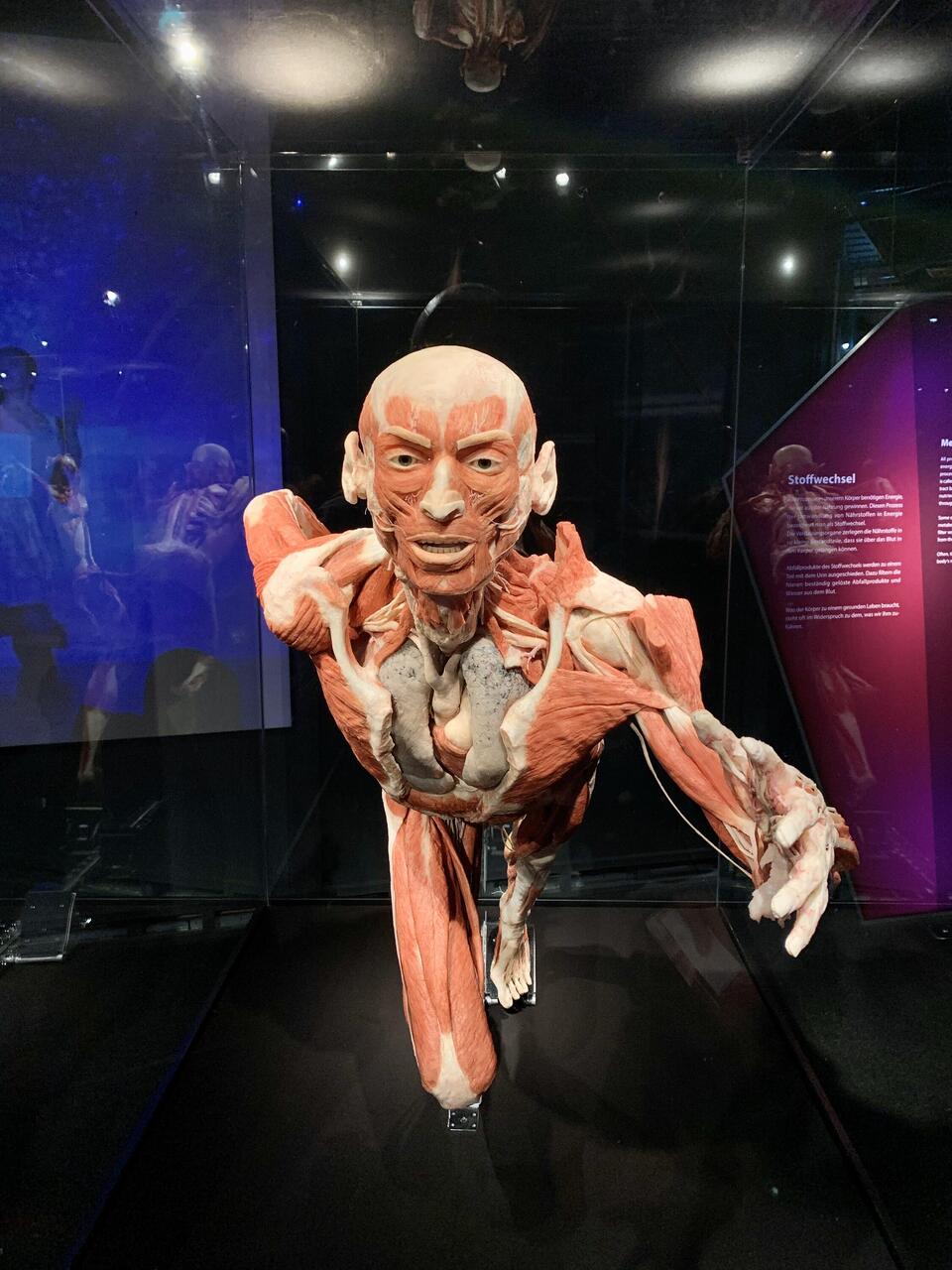
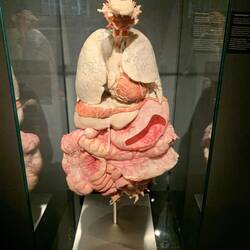
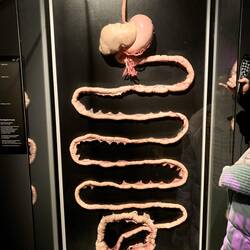
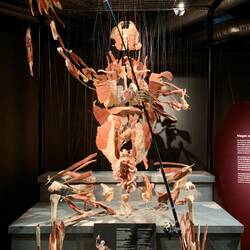
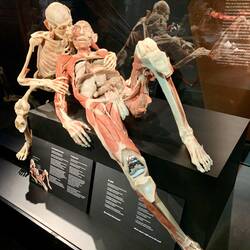
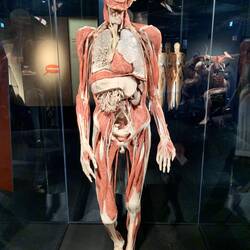
    Plastination is a technique or process used in anatomy to preserve bodies or body parts, first developed by Gunther von Hagens in 1977. The water and fat are replaced by certain plastics, yielding specimens that can be touched, do not smell or decay, and even retain most properties of the original sample.

    Four steps are used in the standard process of plastination: fixation, dehydration, forced impregnation in a vacuum, and hardening.[3] Water and lipid tissues are replaced by curable polymers, which include silicone, epoxy, and polyester-copolymer.
    The exhibition that I saw in Berlin was primarily focused on the human species with many insights around long term health issues that we as humans should be aware of and prepared to manage with better nutrition and exercise habits.
    Meer informatie

  • Stasi Museum (cont’d)

    21 december 2019, Duitsland ⋅ ☀️ 8 °C

    The centrepiece of the exhibition is the office and working quarters of the former Minister of State Security – i.e. head of the Stasi – Erich Mielke. The museum is operated by the Antistalinistische Aktion Berlin-Normannenstraße (ASTAK), which was founded by civil rights activists in Berlin in 1990. It aims to foster the development of the museum as a "centre for the collection, preservation, documentation, rehabilitation and exhibition of evidence and research materials relating to East Germany".Meer informatie

  • Stasi Museum

    21 december 2019, Duitsland ⋅ ⛅ 8 °C

    One has to see it to believe it but the level of intrusion into the lives of every citizen of the GDR is mind boggling.
    The Stasimuseum is located in House 1 on the former grounds of the headquarters of the GDR Ministry for State Security (MfS). The building was erected in 1960-61 as the offices of Erich Mielke, who served as Minister for State Security from 1957 until the end of the GDR.
    On 15 January 1990 demonstrators took over the Stasi headquarters.
    A week later, the Central Round Table, a committee made up of representatives of the SED dictatorship and civil rights groups, decided that a “memorial and research centre on GDR Stalinism” should be established in House 1. When nothing came of this declaration of intent, members of the Berlin citizens’ committee and other civil rights activists took action and began securing the historic site.
    In August they founded the association “Antistalinistische Aktion e.V.” (ASTAK). On 7 November 1990, it opened the Research Centre and Memorial at Normannenstrasse with an exhibition titled “Against the Sleep of Reason”. House 1, later named the Stasi Museum, has been open to the public ever since.
    The offices of Erich Mielke are preserved in their original condition and form the centrepiece of the historic site.
    Since 1990, ASTAK has shown different exhibitions, providing information about the State Security and how its activities affected the GDR population. The permanent exhibition “State Security in the SED Dictatorship,” which the association created jointly with the Stasi Records Agency, opened in House 1 in January 2015.
    Meer informatie

  • World Clock

    21 december 2019, Duitsland ⋅ ⛅ 7 °C

    The sixteen ton world clock was opened to the public on 30 September 1969, shortly before the twentieth anniversary of the German Democratic Republic, along with the Berlin TV Tower (Fernsehturm). The erection of the clock was part of a larger plan to expand and reorganize Alexanderplatz as a whole. At the end of the renovations, the public square was four times larger than it was at the end of the World War II.

    The clock has become since the 1970s the scene of protests, as well as a landmark which Berliners living near the area use to meet others.

    On 12 May 1983 the Bundestag deputies of The Greens, including Petra Kelly, Gert Bastian and three other deputies, unrolled a banner with the inscription "The Greens – swords to plowshares" before the world clock and were arrested.

    On the occasion of the 40th anniversary of the German Democratic Republic on 7 October 1989, opposition political groups formed a demonstration which began at the clock and ended at the Palace of the Republic. The state responded by arresting over 1,200 of the protesters. Thirty-three days later, the Berlin Wall fell.
    Meer informatie

  • Berlin TV Tower (cont’d)

    21 december 2019, Duitsland ⋅ ⛅ 7 °C

    The tower allows people to observe the city of Berlin on a 360 degree basis and some of the photos depict the different angles of the city.
    Walking around Berlin really reminds me of how East Berlin would have looked under the GDR regime and some of the apartment blocks in a couple of the photos depict this.
    Interestingly, the city of Berlin has approximately 3.8 million citizens and yet gives the appearance of being vastly different in size to Melbourne.
    Meer informatie

  • Berlin TV Tower

    21 december 2019, Duitsland ⋅ ⛅ 6 °C

    Situated in Marien quarter (Marienviertel), close to Alexanderplatz in the locality and district of Mitte, the tower was constructed between 1965 and 1969 by the government of the German Democratic Republic (East Germany).
    It was intended to be both a symbol of Communist power and of the city. It remains a landmark today, visible throughout the central and some suburban districts of Berlin. With its height of 368 metres (including antenna) it is the tallest structure in Germany, and the third-tallest structure in the European Union.
    Meer informatie

  • Eastside Gallery - Berlin

    20 december 2019, Duitsland ⋅ ⛅ 7 °C

    The East Side Gallery is an open-air gallery in Berlin. It consists of a series of murals painted directly on a 1,316 m (4,318 ft) long remnant of the Berlin Wall, located near the centre of Berlin, on Mühlenstraße in Friedrichshain-Kreuzberg.
    The gallery has official status as a Denkmal, or heritage-protected landmark. According to the Künstlerinitiative East Side Gallery an association of the artists involved in the project, "The East Side Gallery is understood to represent a monument to the fall of the Berlin Wall and the peaceful negotiation of borders and conventions between societies and people", and has more than three million visitors per year.

    The Gallery consists of 105 paintings by artists from all over the world, painted in 1990 on the east side of the Berlin Wall. The actual border at this point had been the river Spree. The gallery is located on the so-called "hinterland mauer", which closed the border to West Berlin.
    Meer informatie

  • Neues Palais

    20 december 2019, Duitsland ⋅ ☀️ 9 °C

    This was built by Frederick the Great as result of an unforeseen victory against the Russians.
    He spent so much money on the palace that he almost bankrupt himself.
    He used the palace to greet important people however he didn’t live in the palace very much as he preferred the palace called Sansouci.
    The kaisers took over living in the palace after Frederick passed as the whole area is grandiose and palatial.
    Meer informatie

  • Palace Sansoucci

    20 december 2019, Duitsland ⋅ ☀️ 9 °C

    SanSouci palace was the palace built to indulge the kings whim for a carefree life.
    As with all palaces it is grandiose and lavish. The architecture has a baroque influence and atypical of the rest of the style of the area.Meer informatie

  • Potsdam Schloss Cecilienhof

    20 december 2019, Duitsland ⋅ ☀️ 8 °C

    We decided on a guided tour atop a double decker bus to sightsee around Potsdam. Potsdam is located on an island and has 130,000 inhabitants and is the capital of Brandenburg.
    The oldest building in Potsdam was originally a greenhouse and then turned into stables as they were seen as being more important especially by Frederick the Great who was a great conquerer and believed in powerful armies. He lead Prussia to become one of the most powerful countries in the world at the time.
    Potsdam has always been a city of soldiers and has a replica Brandenburg Gate interestingly Potsdam is renown for many fantasies with its architecture.
    Potsdam like so many cities of the day has a city wall for defense and safety.
    We first visited a palace where the famous Potsdam conference was held at the end of WW2 between Churchill, Stalin and Roosevelt to decide on important territorial issues at the end of the war.
    Meer informatie

  • GDR Museum and Christmas Market

    19 december 2019, Duitsland ⋅ ⛅ 8 °C

    On our way to another Christmas market we visited a memorial to commemorate the futility and sorrow of war as well as the GDR museum to get a glimpse of what life was like living in the GDR (German Democratic Republic). The irony behind the name is breathtaking as the GDR had no democratic processes in place in any part of their political or societal decision making.

    One of the amazing things for me is the Christmas spirit and the amount of gluhwein being drunk at these markets. There is also an amazing array of different traditional German food which adds to the atmosphere from sweet bakery treats to smoked salmon and large BBQ’s cooking bratwurst sausages, steaks and burgers.
    Some of the food combinations are amazing for example large bowls of spinach with a bratwurst sausage plonked on top and potatoes filled with all sorts of toppings as well as gluhwein that has different spirits added to it like Cointreau and Vodka. Perhaps the highlight for me in the food stakes was a crepe that was cooked in front of me and topped with cinnamon sugar and the folded into four...so good to eat. The potato fritters were also especially good. The German diet is very largely biased toward carbohydrates and a meat protein of some description.
    Meer informatie

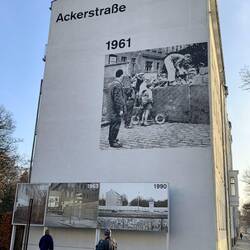
  • Berlin Wall (cont’d)

    19 december 2019, Duitsland ⋅ ☀️ 8 °C

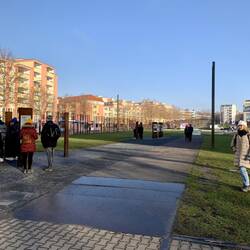
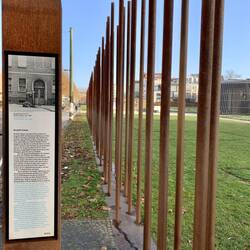
    This is a compilation of some of the other attractions of the German Wall visit.
    The four upright vertical steel girders represented the site of one of the GDR guard towers. We also visited the Berlin Wall museum which profiled the type of people who tried to escape some of which were successful and some of which perished.
    There was a well documented section of the wall called the “death strip” which was 80-100 metres wide between both walls and was patrolled by the GDR soldiers with orders to shoot to kill anyone who was attempting to escape from the East.
    The wall was constantly being upgraded over a 30 year period so counteract more sophisticated attempts to escape by the increasingly frustrated people of the GDR whose rights were being increasingly stripped and also by the fact that families and relatives had been separated since the wall was constructed.
    Meer informatie

  • Berlin Wall & Museum

    19 december 2019, Duitsland ⋅ ⛅ 4 °C

    Walking with my beautiful wife in Berlin and off to see the TV tower which was curiously constructed in the East German sector as it represents modern technology and architecture something the GDR was not exactly renowned for. We decided to walk directly to the Berlin Wall though due to the fact it was quite foggy and our view of the city would have been shrouded in fog.
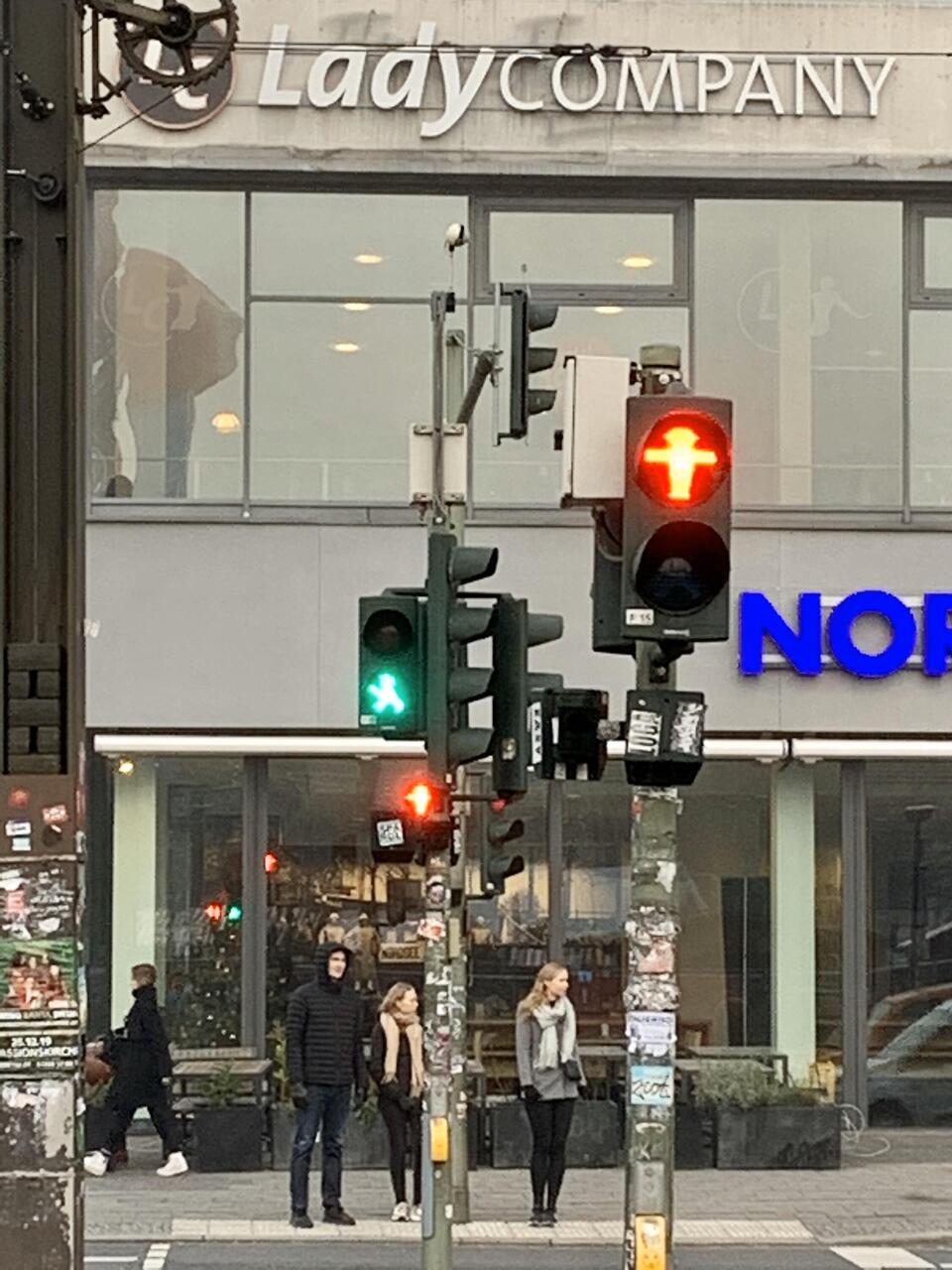
    The traffic light crossings are curious as they represent a link with the past and the old GDR regime. They have become so popular that they are replicating them throughout Berlin hence my photo.

    In this section of the wall some of the wall has been preserved including one of the old watchtowers as well as some new architectural sculpture pieces (steel rods) which represent where the wall once stood. There are many stories of the extraordinary lengths people found in their attempts to live a life of freedom.
    In all some 190 people died trying to cross the wall including through tunnels, jumping from windows and simply making a run for it.
    Meer informatie

  • Gendarmenmarkt

    18 december 2019, Duitsland ⋅ ⛅ 7 °C

    This was our first experience with a traditional German Christmas market and it is quite an experience!
    There are a variety of traditional German foods such as crepes, bratwurst, turkey, raclette, gluweine and other Christmas paraphernalia like baubles, wood carving, leatherwork and coats and jackets etcMeer informatie

Creëer uw eigen reisprofiel

Gratis

QR code

FindPenguins voor iOSFindPenguins voor Android