• Nice

    8 Julai 2023, Perancis ⋅ ☀️ 31 °C

    Today was one of the more chilled days we’ve had in a while!

    Daniel went for a run in morning before we went down to the beach for a chilled and relaxing day. We read quite a bit and took some dips in the water and, although it was windy again, we found a spot that wasn't so busy next to private beach area (we just used the public beach areas as the private daybeds are the equivalent of around $100 for the 2 of us for the day!)

    During the afternoon, we went to get ice cream at our favourite place which we went to yesterday (Fenocchio). Daniel had mango and pistachio and Gab had banana and milk caramel this time. We then walked up to the park with lookout points to see over all of Nice (Parc du Château Escalier). We took in some incredible views before making our way down to the token ‘I Love Nice’ sign. It was sooo hot (around 35 degrees) so opted for some happy hour drinks of a pint of beer and an aperol on our way back to the Airbnb.

    After a lovely hot day, we chilled out in the place, cooked dinner and watched a movie.
    Baca lagi

  • Marseille —> Nice

    7 Julai 2023, Perancis ⋅ ☀️ 29 °C

    We checked out of our Airbnb and jumped on a train to Nice. It took around 2.5 hours but it was a nice easy journey along the French Riveria. We checked into our Airbnb around lunch time.

    We headed straight to the beach, walking through the main square (Place Massena) along the way and then chilling out on the rocky (and very windy!) beach. We stayed a few hours chilling on the beach and attempting to get in and out of the water multiple times which is a challenge sometimes with all the huge cobblestones (we will never take sand for granted at home!) We then ventured into the old town to explore the streets and then got some gelato at a place which had been recommended to us called Fenocchio. They had over a hundred flavours with everything from multiple chocolate flavour, every time of fruit, herbs and spices and even beer flavour! We tried a few different flavours including rhubarb and lemon for Daniel and Gab had lychee and mojito (yes it was alcoholic!).

    We did some shopping on the way back to our place before freshening up and heading out for dinner. We had dinner in the old town in an Italian / Niçoise style restaurant. We shared a plate of Niçoise specialities including different tried tomatoes and eggplants, socca bread and grilled octopus which was delicious! We then shaded a yummy truffle pizza to go with Gab's pina colada and Daniel's beer.
    Baca lagi

  • Marseille

    6 Julai 2023, Perancis ⋅ ⛅ 28 °C

    We had a very different day today as we journeyed out of Marseille to explore the lavender fields in the region of Provence (specifically, around the town of Valensole). It was pretty amazing seeing the lavender fields as they are only in bloom around 3 weeks a year from late June to early July.

    Rather than paying the $300 for a normal car for a same day return we opted for a van option - we guessed this would typically be hired by removalists but we didn’t care, it only cost $60 (though we did look and feel pretty funny!) We made our way out of Marseille (with some serious concentration displayed by Daniel to navigate out of the right Marseille streets!) and onto the highway en route to the lavender fields.

    We could smell them before we saw them, and when we saw them they were incredible - absolute seas of purple/lavender for which photos could not do justice! We made a quick stop in the fields for some photos and to walk around. We stopped at a lavender distillery and bought some soap (which will definitely make our bags smell better!)

    We then drove to the town of Valensole and visited the town. We explored the chapel, beautiful old streets and shops before trying some lavender ice cream which was delicious! The man at the ice cream shop also let us try some other flavours of ice cream which are traditional to the area such as hibiscus (delicious!), thyme ice cream (interesting!) and carnation flower (also nice!)

    We then hopped back on the ‘lavender route’ and continued driving through the region making a few more stops along the way to take in the sights and smells. It is quite easy to stop on the side of the road (even in our huge removalist van!) for photos and to see the fields closer but there were literally kilometres of fields to view from the car. It looked like there were purple hills around us!

    We then proceeded to drive through the Verdon Gorge which is very scenic. There were lots of campervans around so we didn't feel so small here! We made a stop by the very blue water! We wanted to jump in (it was 30 degrees during the day) but continued back to Marseille

    We then made our way back to Marseille and had to contend with some of logistics of returning a hire car - filling up petrol to avoid the exorbitant costs of the hire company filling up! After trying two different petrol stations (and Gab speaking French to attendants at the service stations trying to understand why the diesel wasn't working and our Aussie credit cards weren't being accepted), it was clear that they weren’t accepting our cards and so we accepted defeat and decided we would return the van and cop the costs. Fortunately, when we returned the van and were told about the fuel, we explained what had happened and the attendant didn’t charge us for the fuel! It was definitely a cherry on top of a fantastic day!

    We went back to the Airbnb, did a workout and chilled out as well as some forward planning for later in the trip before watching a movie and going to bed.
    Baca lagi

  • Marseille

    5 Julai 2023, Perancis ⋅ ⛅ 26 °C

    We enjoyed a good nights sleep in a very comfortable bed before waking up to explore Marseille! It was a beautiful warm day but not very humid which was nice.

    We did some quick shopping and had some breakfast before taking the ‘scenic’ route to the beach (about 30min longer than expected but we definitely saw more of Marseille!). We walked through the old port area and arrived at Plage des Catalans (Catalans Beach). We chilled on the beach for a few hours which was very relaxing! We then enjoyed some ice cream as we walked back to the main port.

    We decided to catch a half an hour ferry across to an island just across from Marseille, Port du Frioul, for the afternoon. It was really nice to see the view back to Marseille and of the surrounding areas. We explored the somewhat deserted island with interesting cliff faces and rock formations (which was eerily quiet!). We learnt that it used to be a quarantine station with a quarantine hospital and it also had large forts and a castle. We chilled on one of the beaches with crystal clear water and lovely views and Gab finished another book on her kindle (getting lots of reading done on the trip!) We then walked through some of the shops/restaurants that are on the port and had some crepes for a snack to get us through to dinner.

    We caught the ferry back to the mainland and took the much more direct route back to our Airbnb for dinner.
    Baca lagi

  • Brussels —> Marseille, France

    4 Julai 2023, Perancis ⋅ ☀️ 29 °C

    We checked out of our Airbnb and made our way to the train station to continue our overland journey across Europe!

    We chilled at the station for a few hours and even got some waffles (this time covered with milk and dark chocolate) to say goodbye to Belgium :)

    We boarded the train in the afternoon and had a changeover in Paris (across one very busy metro line with our bags) to another main station where we boarded the train on route to Marseille. This train is one of the super fast TGV bullet trains that would cover a distance of nearly 800km in about 3 hours!

    We arrived in Marseille around 9pm and checked into our Airbnb and went to bed.
    Baca lagi

  • Brussels

    3 Julai 2023, Belgium ⋅ ☁️ 19 °C

    We started the day with a call home before heading out on our day of exploring the beers of Belgium!

    Our first stop was Brussels oldest brewery where we learnt about the process required to brew ‘Lambic’ beer. The production of this beer does not use modern cooling tanks and temperature control, and as such cannot be brewed in summer when it is too hot. Instead, it relies on the natural weather environment and traditional methods like using wind to cool the beer as it is produced. It was very cool seeing the entire process from mashing the ingredients through to bottling and then finished the tour with a few samples of the lambic beer. It had a very interesting taste and is more similar to a wine rather than a beer, which makes sense given it is aged in a oak barrel. This type of process of making wine is only now done in Belgium and is very rare.

    We walked for a bit from the brewery and checked out some more comic book murals across the city (and we even checked out a comic book store which was very cool!)

    Our next stop involved ticking off another important Brussels food tradition - mussels! We had some delicious mussels and fries accompanied by a couple of very flavourful beers, a red rosè (made with raspberries) and triple amber!

    There was one last "must eat" item in Brussels and that was chocolate! We went to Mary’s, the oldest shop in Brussels (which was the first to officially be the chocolate of choice for the royal family). Mary's was highly recommended by our tour guide from yesterday and they use traditional chocolate making techniques so we had to give it a go! It now has chains all over Belgium. We tried a couple each including a salted caramel dark chocolate, peacan chocolate and dark chocolate mousse (which was our favourite!) The chocolate was nothing short of delicious and gave us the energy to continue on with our pub crawl!

    We went to the Delirium Cafe, where we tried their ‘Beer Meter’ - a long paddle of 10 quite sizeable tasting beers! We enjoyed the various flavours as we made another call ‘home’ - to Daniel’s parents in the US!

    We made our final stop at a bar called Gist (dutch for yeast), which brew their own beers and just so happened to have happy hour whilst we were there! We enjoyed some strong sours (which Gab loved), amber and dark beers as the days' drinking was starting to catch up with us! We had some great chats and lots of fun sitting outside enjoying the little bit of sun.

    We made it back to the Airbnb in one piece to have dinner and watch a movie and then called Daniel’s cousins in the US before heading to bed!
    Baca lagi

  • Brussels

    2 Julai 2023, Belgium ⋅ ⛅ 18 °C

    Daniel started the day with a run while Gab chatted with friends from home. We then headed to the Grand Place to meet up for our free walking tour! This was one of the longest and also most informative tours we had done so far on our trip with a very charismatic guide called Adrien. We learnt a lot during our 4km tour which went for almost 3.5 hours (with a short break half way through where we bought traditional frites!)

    We learnt some interesting things such as:
    - Belgium has 3 official languages being French, Dutch and German. 60% of the country is Dutch speaking and 40% of the country is French speaking (and less than 1% are German speaking). Brussels is the only multi-lingual city in Belgium and everything is supposed to be displayed in French and Dutch, however, 90% of people living in Brussels speak French and 10% speak Dutch.
    - The site of the Grand Place was originally a market back in 11th century and it was later destroyed during conflict and rebuilt. The Grand Place is very impressive and contained the city hall (which is still used as a city hall today) and houses that were for different guilds (such as for writers, painters and bakers).
    - In Belgium, people have to get married in their local city hall so people in Brussels have to get married on Saturday mornings in a small hall in the city hall (with a 20 minute time slot).
    - The city hall with the large spire is the only original building standing in The Grand Place as all others had burnt down and been reconstructed. The spire is actually not in middle of building and as such the building is not symmetrical (the original design was symmetrical but then they decided to add to one side of the building but there wasn't enough room to make it symmetrical).
    - There is a massive comic book industry in Belgium, including their most famous character - Tin Tin! There are over 70 comic book murals scattered on walls around the city of Brussels. Reading comic books is very popular for people of all ages and the French speaking comic book industry sells 10million copies every year (unlike the English speaking industry which serves many more people but sells around 1million copies a year).
    - We stopped at the Manneken Pis - a statue of a little boy peeing from the 13th century. No one knows who and why it was put there (although there are many crazy legends!) So, basically the statue is famous for being famous but the people from Brussels don't mind it being their unofficial mascot - they don't take themselves seriously! There are a group of people who dress up the Mannekin Pis and he has over 1000 outfits. We saw him dressed up in a uniform of a student union.
    - There is a lot of diversity in beer which is why it is so famous in Belgium! There is said to be around 25,000 different beers in Belgium, and about 80% of beers aren’t exported, so try them while you are there (which we plan to do!!)
    - Belgium has an interesting history having been controlled by the Spanish, French and Dutch at different times. The Belgian Revolution was in 1830.
    - There is a river under Brussels (called River Senne) which was covered up to get rid of the problem of cholera which killed many people in Brussels in the last 1800s.
    - Traditional frites (fries) in Brussels are made by twice fried potatoes in beef fat oil at two different temperatures - delicious!
    - We learnt all about chocolate! The cacao bean was bought to Europe in 1600s but solid chocolate as we know it was a 19th century creation. There were a number of rules which were followed closely in Belgium including that you can’t have anything less than 45% cacao mixture otherwise can’t call it chocolate, you could only use certain ingredients and you can't use vegetable oil instead of cacao. So for example, companies such as Cadbury/Hershey had to rename their products to chocolate-flavoured candy. These rules are mostly no longer in place but most Belgian chocolatiers still follow these traditions which is what makes the chocolate so good!

    We stopped for a quick lunch break and then tried our next Belgian delicacy - waffles! We were recommended to get one from a food truck as it is the freshest and it did not disappoint, the taste was incredible!!

    We then continued to walk around the city and spot some more of the comic murals, more peeing statues (one of a girl called the Jeanneke Pis and one of a dog called Het Zinneke!) and then a very interesting looking concrete truck made out of steel!

    We finished the day with a few authentic Belgian beers in an old school pub recommended by our walking tour guide (called Les Brassiers). Gab tried an amber beer made by monks (a trappist ale) called Orval and Daniel tried a popular ale called Jupiler. We then headed back to the Airbnb.
    Baca lagi

  • Amsterdam —> Brussels

    1 Julai 2023, Belgium ⋅ ☁️ 20 °C

    We checked out of our hostel in Amsterdam and jumped on a direct train to Brussels, Belgium! We checked into our Airbnb around 2pm and were grateful for a bit of extra space after a couple of weeks in hostels.

    We had a brief walk through the main square of Brussels, the Grand Place, before heading to the European Parliament. This is one of the three main buildings which conduct the EU parliament functions, with the other two being in Strasbourg and Luxembourg. The European Parliament representatives are elected by citizens from each nation so they act on behalf of the citizens who elected them.

    The site also includes the places for the European Commission (which acts in the interests of the EU as a whole) and European Council (which acts on behalf of EU members states).

    The Parliament musesum building was really well laid out and was very interactive, explaining the functionality of the EU as well as the in depth analysis of how the EU was formed over time, starting with the first six countries back in 1951 - Italy, France, Luxembourg, West Germany, Netherlands and Belgium.

    We learnt about the beginning of the EU and the many agreements which led to the EU being the institution it is today. In short:
    - The idea of a European union came about after WWII. In particular, Germany had huge resources in the Ruhr area for steel and coal and other countries were concerned that this industrial power should not ever be used again for war and should not be exclusively used by Germany.
    - 9 May 1950 - Ultimately this led to the Schuman Declaration which related to the pooling of resources such as coal and steel in Europe. The 9 May is now still recognised as "Europe Day" and it saw the first cooperation between France and Germany and this was solidified by the Treaty of Paris the following year.
    - 1957 - The Treaty of Rome was signed which related to European economic community and European atomic energy cooperation. Interestingly, the treaty had not been translated into all of the necessary languages prior to signature but there was a French election and to not risk the new French president not agreeing, the parties signed it as soon as possible with a document containing mostly blank pages. This showed the great level of trust which had evolved between the countries at this time!
    - During the 1960s - There was a tug-o-war of ideas as to how the EU would continue (I.e. whether it would be a United Europe or whether it would be a Europe of Nations and how this would look going forward).
    - During the 1970s - This was the start of the use of a European currency unit so they could track currency inflations in different countries. This was the forerunner of the Euro which is used today.
    1992 - The Masastricht Treaty was signed which led to greater cooperation between the parties.
    1995 - The Schegen Agreement was signed which meant there was free travel between European borders.

    The Parliament musesum also explained a lot about how world history has impacted on the EU and also how the EU provides various types of aid not only to its members but also all around the world. It was a very informative experience with a lot of information to absorb!

    Afterwards, we made our way back to the Airbnb after doing some shopping and then had a chilled movie night.
    Baca lagi

  • Amsterdam

    30 Jun 2023, Belanda ⋅ ☁️ 19 °C

    We spent our final day in Amsterdam with a tour of the northern countryside. The Netherlands has 12 provinces and Amsterdam is in the North Holland province. We visited a few more areas in the North Holland province. From the bus, we saw how flat most of this area is. We learnt that the Netherlands means "low lands" as most of the country is below sea level.

    We started with a stop just outside Edam at a cheese making factory where we learnt all about the traditional Dutch way of making cheese. It takes a massive 10L of milk just to make 1kg of cheese, and then once hardened the cheeses are placed in a salt water box for up to 48 hours to create the protective wax coating which enables it to last unrefrigerated for up to 1 month. We learnt that cheese is also broken up into 3 different ‘ages’ - up to 4 weeks is young cheese, up to 4 months is middle aged cheese and over 1 year is old cheese. We finished the cheese experience by trying lots and lots of yummy cheeses with many different flavours such as beer, pesto, coconut, garlic, truffle, lavender and many other interesting flavours. We really enjoyed the jersey cheese, goat cheese and sheep cheese (particuarly the aged ones) and Gab loved the truffle cheese.

    After probably having a kilo of cheese between us, we then went back on the bus and made our way to the harbour town of Volendam which is a fisherman's town. There, we enjoyed a nice walk along the water and looked into the shops. We then travelled to the town of Edam. This town is famous for their cheese and we went for a very scenic walk through the streets and along the small canal. It is a very pretty small town and we enjoyed walking along the historical streets.

    Our final stop of the day was Zaanse Schans, a very touristy spot but one we couldn’t miss! Here we managed to tick off the last traditional Dutch thing - clogs! We walked through a clog museum and saw a clog making demonstration where they are able to make a pair of clogs in about 5 minutes using machines. This is much faster than the traditional 3 hour it would have taken an experienced clog maker back in the day! Once complete, clogs are waterproof and are certified as official safety shoes for construction sites! We finished our stop with a walk past some Dutch windmills there before jumping back on the bus and heading back to Amsterdam.

    After finishinh the tour in the afterrnon, we went back to the hostel to pack up our stuff and played some cards to chill before heading off to another country tomorrow!
    Baca lagi

  • Amsterdam

    29 Jun 2023, Belanda ⋅ ☁️ 22 °C

    We had the proper Dutch experience today by starting with hiring bikes and heading north out of the city!

    We cycled through Het Twiske, a beautiful open park area which had lots of greenery, lakes and animals (including cows and highland cows) - very fun to ride past! We even saw a lovely windmill and some nice lakes. It started to rain a little bit but it passed pretty quickly.

    We made our way back to the hostel to have a quick lunch and then continued south into the main city. We first jumped on the ferry on our bikes for a couple of minutes to get into the cuty. We had lots of fun exploring the canals of Amsterdam and continued out of the city towards the regatta centre. We had a ride around the regatta centre before heading back to the city for a very important appointment - the Heineken Museum! At this point, we were glad to be off our bikes because we had ridden about 60km!!

    We checked in to the Heineken musesum and commenced our tour back in the late 1900s, when Heineken was first brewed. We learnt a lot about the worlds most famous beer as we explored the museum. Some things we learnt included that:
    - The main Heineken brewery in the Netherlands is the biggest brewery in Europe (the musesum site is no longer used for brewing beer).
    - Heineken was the first imported beer in US.
    - There is a special ‘Heineken A Yeast’ which is the secret ingredient that gives Heineken its distinct taste. Only 11 brewers in the world know the recipe and it’s kept under lock and key until needed for a new brewery.
    - 95% of Heineken is water.
    - The alcohol free Heineken (called "Heineken 0.0") is made exactly the same way but the beer is boiled at the end to get rid of the alcohol (which is probably why it is one of the best no-alcohol beers!)
    - Heineken was the first beer brand on TV.

    As we progressed through the museum, we went through a 4D experience where we became part of the beer, explored the old brewery vats and learnt about the importance that sports sponsorship has had on the development of the Heineken brand. We finished the tour with a couple of well deserved cold Heinekens!

    We completed our Dutch experience by cycling to a spot for dinner and having a traditional dinner of bitterballs (fried mystery meat), stampoot (vegetables and potatoes mashed together with meat on top) and finished with dessert of Dutch pancakes. Absolutely delicious! We cycled back to the north of Amsterdam and returned our bikes late before walking back to the hostel for a much needed rest for our legs!!
    Baca lagi

  • Munster, Germany —> Amsterdam

    28 Jun 2023, Belanda ⋅ ☁️ 16 °C

    After a 4am wake up, we got to the train station and caught our 5am train en route to Amsterdam. Of course, because we had woken up at 4am, all the trains were on time and there were no issues with the connections!

    We arrived in Amsterdam around 9am and walked to our hostel in the North of Amsterdam (which luckily is very easy to get to with a free ferry which goes every 5 minutes and only takes a couple of minutes!) There, we had a late breakfast and chilled out for a bit.

    We then walked back to the centre in the afternoon and went on a walking tour of Amsterdam, learning interesting facts along the way as we explored the streets and canals:
    - Amsterdam was named because there literally used to be a ‘dam of amstel’ in 1300, when the city was named.
    - The red light distinct is called the vollen by locals. It started because there were lots of sailors coming into Amsterdam and so there was a lot of prostitution which kept the sailors away from local ladies. The church which is right next to the red light district used to be busy with people repenting for their sins and then eventually the church sold "passes" to people before they visited the red light district to absolve them of their sins in advance.
    - The structures next to the canals are sinking (which is pretty evident by some of the lopsided buildings!) There is a 20 year maintenance plan in place so there is a bit of construction going on to allow them to fix up the foundations of these properties.
    - The buildings used to be taxed in width so there is lots of narrow buildings along the canals! There are winches on top of buildings to get large items into the buildings which are still used by people today.
    - Officially, coffee houses are able to sell 5 grams per person per day of weed. The government has implemented programs of slowly trying to limit the use by tourists. Many locals are taught about weed when they are young and are not so interested in using it.
    - We visited a spinning house for women where women were forced to work at one stage when they were found guilty of prostitution (at a time when it was illegal - it has bounced between being legal and illegal at various times in history).
    - In the Netherlands, there are more bikes (21 million) than people (17 million). You can definitely see this by looking at any street (and even more so when you tried to cross the street!)
    - We also visited an area of the city which used to be mostly occupied by a Jewish population prior to WWII. The architecture there is quite different and it is because the area was largely reconstructed after the war. Most of these people were removed from their home when Amsterdam was occupied but then in 1945, there was a particularly cold and difficult weather for the people remaining in Amsterdam so people stole furniture for burning fires and destroyed part of the buildings for materials for fires and to survive as they were all unoccupied.

    We finished the walking tour by trying some stroopwaffles which were very delicious!

    After the tour, we walked the red light district to do some ‘window shopping’ followed by doing some actual grocery shopping (and a quick visit to the LEGO shop) before heading back to the hostel for a much needed early night!
    Baca lagi

  • Denmark —> Munster, Germany

    27 Jun 2023, Jerman ⋅ ☁️ 23 °C

    The day that will forever be remembered as train (failure) day! We were supposed to end up in Amsterdam around 10pm after 3 trains (and 12 hours) but only managed to make it about 3/4 of the way after 4 trains (in around 15 hours)!!

    Train 1 - Copenhagen to Flensburg:
    We arrived at the station 30min before our supposed train time at 9:30am, only to find that our train had departed 30min early for no apparent reason! Thankfully, we were able to get on the next train 2 hours later which would have got us to Amsterdam around midnight with the right connections - that’s when the real problems started!! We were supposed to go to Hamburg in Germany but as we approached the Denmark/Germany border about 2 hours in, we were told that the train staff weren’t trained to drive the train in Germany so we had to get off at Flensburg, just inside the German border (very strange excuse!!)

    Train 2 - Flensburg to Neumunster:
    We were slightly late into Flensburg and so had to wait approx 40min for the next train. This train actually did come on time, however, the schedule showed the train going through to Hamburg but it terminated mid-way and we had to get off and change trains. We stood for this whole 2 hour train squashed up against the doors with our bags.

    Train 3 - Neumunster to Hamburg:
    The train from Neumunster arrived on time, however due to the backlog of people throughout the German train system, each stop took much longer as people were getting on and off. There were a number of reasons stated for the delays such as medical emergencies, people being on the tracks and repair work. We had to stand for this whole hour train and got separated so we were sending each other strange WhatsApps trying to figure out what was going on. We ended up arriving into Hamburg late and so we needed to catch a later train towards Amsterdam.

    Train 4 - Hamburg to Munster:
    This is where we knew we were doomed. We actually got on a train and then got off the train before it departed once it started showing we wouldn’t be in Amsterdam until 6am tomorrow! We jumped on another train, and at this point we were just aiming to get as close to Amsterdam as we possibly could before finding accommodation for the night. The 2 hour train journey was fine as we actually had a seat on this one - which was a relief after running around with our backpacks on across stations all day (and sometimes wearing them on trains)! We watched some Netflix and, as there was a cafe on board, we decided to reward our efforts of the day with our first German beer on the train!

    We made it to the German city of Munster (1hr 30min after the train was supposed to arrive), went to the rail information desk to get tickets for the next day and managed to get accommodation at the Ibis Budget around midnight, so we could have a quick nap before needing to be up to catch our 5am train to finish our journey to Amsterdam.

    This definitely wasn’t the way we intended to spend our first night in Germany on the trip but all part of the fun of travelling!
    Baca lagi

  • Copenhagen

    26 Jun 2023, Denmark ⋅ ⛅ 25 °C

    We thought a day of rest would be appropriate after amassing 23,000 steps yesterday - so naturally we decided to better that by clocking up over 25,000 steps (and then a long gym workout!)

    We started with a visit to Nyhavn, the area which typically comes up in a google search of Copenhagen - a very pretty harbour area with the classic colourful houses and lots of shops and restaurants along the water. We then made our way to the ‘Little Mermaid’ statue, based on the story by the Danish author, Hans Christian Andersen. Apparently, it has been used as a political forum to express messages over time!

    We then made our way to Kastellet, a fortress which used to defend Copenhagen overlooking the Baltic Sea. We walked the walls of the star-shaped fortress, imagining the protection this would have provided to the Danish people. We then walked to the ‘Genetically Modified’ Little Mermaid statue which was sculpted because apparently people weren’t happy with the original statue - very strange!

    We then made our way back to the hostel in the afternoon where we made use of the facilities and enjoyed a much needed gym workout for over an hour and a half - we both felt great afterwards! Luckily, it rained in the late afternoon while we were in the gym (after it had been beautiful and sunny the whole day we had been out!)

    We spent the night chilling, booking some things for our next travels and playing cards in the hostel, making the most of the happy hour and live music!
    Baca lagi

  • Copenhagen

    25 Jun 2023, Denmark ⋅ ⛅ 24 °C

    We started our 100th day of the trip right by doing a free walking tour (we love doing these when we visit new cities)! We met at city hall, which was actually modelled after a cathedral in Siena, Italy. We found out that this was actually the 6th city hall and it was constructed in 1905.

    We then proceeded to walk through the city, learning a lot of fun facts along the way, including that:
    - Like Oslo and Stockholm, Copenhagen has also experienced a lot of large fires (it seems to be a theme in Scandinavia where they loved building with wood!!) In 1728, there was The First Great Fire which was started by a candle in someone's house and the couple blamed it on their 7 year old son! That poor kid was blamed for having burnt down half the city!
    - In 1795, Copenhagen had its Second Great Fire where the other 50% of the city burnt down. After this, the city made some changes to try and prevent further fires such as making the streets much wider, they changed the corners of the streets so they didn't use 90 degree angles (so it was easier for fire-fighters to get around to houses) and there were rules about the construction materials which had to be used in Danish houses (I.e. they couldn't be made fully of wood).
    - Danes pay a lot of taxes but have free school, university, health care and uni students get paid to go to uni plus support in finding new jobs. This is part of the reason why Danish people always score very high on the "happiness index" being considered some of the happiest people in the world.
    - We walked past the house of the founder of Carlsburg's beer. Carlsburg was founded because the founder wanted to create the best beer in the world and travelled to many European cities to try different beers. He discovered that the first step was to ensure they had clean water and the problem in Copenhagen was that the beer there didn’t have taste consistency (because they used different yeasts which always tasted differently). With the king's approval (who just so happened to be a fan of beer), the founder set up a brewery just outside the city walls and discovered a great yeast that they shared with rest of world to help everyone have good beer! The yeast was discovered in 1883 and hence the Calsberg 1883 special beer was born!
    - There are more bikes than people in Denmark and over 50% of people use bikes as transport, with bicycle highways to get from suburbs into main cities. There is quite a bit of bike theft in the city so people usually use their "worst" bike for riding into the city and then their "nice" bike for visiting friends.
    - We had a quick language lesson, learning some phrases in Danish. We like that "hej" is hello and "hej hej" is goodbye. We learnt about the concept of "hygge" (which doesn't have a direct English translation. A lot of English words are derived from Danish/the language the Vikings used. For example, "by" is the word for town/city in Danish so any English towns which end in "by" were Viking towns.

    During the walking hour, we visited a number of nice squares and buildings in Copenhagen including Christianborg which was a palace built for the royal family but they didn't want to use it so it is today used as the Parliament house. We also saw many students wearing particular caps which looked like sailor hats and riding around in trucks playing music loudly and drinking as we walked around. We even saw some of them jumping in the fountains! This is a Danish tradition for when students graduate high school and the trucks drive them around to each family of the families, having drinks all day and night!

    We finished the tour in front of the Royal Palace and then headed into the Marble Church - a very European looking church in the heart of Copenhagen. Of course, we spoke about the modern love story of Prince Frederick and Princess Mary (who met at the Sydney Olympics). Interestingly, we learnt that the Danish royal family is the second oldest royal family (after Japan) so other European royal families have to bow to them when they meet up.

    We then had a walk through the Kings Garden and stopped in the Botanical Garden for a quick lunch break before heading into the Rosenberg Castle. The castle had 3 above ground levels and one basement level, housing many artefacts from the Danish royal family, from paintings to sculptures and even some creepy wax figures of kings and queens! It was the home of where the royal family used to live and then where the royal family housed their dearest and most expensive possessions. We finished off the tour with a viewing of the magnificent Crown Jewels in the treasury.

    We continued our walking through Copenhagen to our last stop of the day, Tivoli Gardens. This is the second oldest amusement park in the world but also contains some pretty gardens, fountains and a lake in the centre. We also went on one of the oldest running wooden roller coasters in the world (built in 1914) which was lots of fun (see funny photo of our faces!)

    We enjoyed some organic burgers at Tivoli for dinner before watching the light and water show in the main lake at 10:30pm to end an incredible day of exploring!
    Baca lagi

  • Stockholm —> Copenhagen

    24 Jun 2023, Denmark ⋅ ☁️ 22 °C

    Today, we only had a half day in Stockholm as we were leaving in the afternoon, so we decided to visit their city hall, which just happened to be celebrating its 100 year birthday!

    We bought our tickets for the bell tower and then went for a nice long walk along the harbour (exploring a different island) while we waited for our time slot. We even managed to come across a ‘beach’ where there were some locals our enjoying the sun! We made our way up the bell tower and had a fantastic view over Stockholm. It was a really nice way to end our time there as we were able to see all the places we had walked the past few days in Stockholm. We had learnt on our walking tour that when the artictect was building the city hall, he visited Copenhagen and measured the height of Copenhagen's spire on its town hall and ended up designing and building Stockholm's spire 40cm higher than the spire of Copenhagen's town hall - another way the Swedes like to poke fun at the Danes!

    We came back to the hostel to get our bags and chill out whilst we waited for our train. We caught the train around 4pm and made a quick change at Malmo before crossing the border over the Oresund Bridge at around 9pm. Daniel was particularly happy about this and in full civil engineer dork mode! The ‘Öresundsbron’ is the longest (8km) bridge in Europe which spans the strait between Denmark and Sweden, but what makes it unique is that it meets an artificial island in the middle of the straight and then continues for another 4km in a tunnel until it meets the Danish coast.

    We arrived in Copenhagen around 10pm and explored our huge hostel and its facilities before turning in for the night.
    Baca lagi

  • Midsummers Eve in Stockholm

    23 Jun 2023, Sweden ⋅ ☀️ 26 °C

    Happy Midsummer Eve! We definitely did not plan our trip around this but found out only a few weeks before we left Sydney that we would be in Stockholm for one of Sweden’s biggest public holidays! It is essentially a celebration of the summer solstice, the longest day of the year which is said to be the ‘middle of summer’. The time is said to have magical powers and there are a number of traditions associated with the day!

    Although most locals leave the city and celebrate in the countryside, there was still a lot happening in the city and we went to an outdoor museum/park type place called Skansen at around 10am after a lovely 45 minute walk along the harbour from our hostel. There was a lot to do there and we started in the Baltic Sea Science Centre, learning about the different animals which are in the Baltic sea and their habitat.

    We then went to the traditional start of Midsummer celebrations, the raising of the Maypole at 11am! We cheered on the folk dancers as they raised the pole (which happened in a number of steps by pullibg ropes up the pole) and then joined in the dancing around the pole, which included some very interesting dance moves! We were pretending to be frogs and other animals and even did dancing involving laundry and other house chores and skipping home from church! We had so much fun and picked up the moves quickly in a big mosh pit around the maypole.

    We then explored the various enclosures containing various Nordic animals, including moose, bison, brown bears, seals, lynxs and even reindeer! We attended a short talk about the reindeer where of course we learnt a lot of interesting information about the reindeer including:
    - Reindeer lose their antlers in the winter time but females take longer than males to lose their antlers (because they are more reliant on the nutrients in the antlers for reproduction). At the end of December, male reindeer have all lost their antlers so Rudolph would most likely have to be female!!
    - Reindeer have a clicking in their knees so that in a snow storm where there is no visibility they can hear and find each other. The babies don't grow this tendon in their knees until they are a year old so to help protect them from being hunted by predators.
    - Reindeers' predators in Sweden are brown bears, wolverines and lynxes.

    We then attempted (and succeeded!) to tie our own wreaths - another tradition of Midsummer. Gab’s was quite delicate (not as many leaves) whilst Daniel’s was very heavy (many leaves)! We then of course wore these for the rest of the day!

    We returned back to the Nordic animals to see the animals which we hadn't seen and managed to catch the grey seals being fed their afternoon fish.

    In the later afternoon, we attended a talk by a ‘wise old lady’ who shared us the stories of old wives tales used to describe the presence of spirits and how to heal ailments (like taking three strands of hair, spitting on them and throwing into a fire to get rid of a headache!). She also explained special spirits and traditions in relation to Midsummers (which is known to be a time where trolls and faires and other creatures are more prevalent because they are confused by the sun always being up whereas usually they are only around at night!)

    After an hour or so of hearing different tales (in both Swedish and English), we then had to seek shelter for about 30min whilst a massive storm hit Stockholm before we continued on a walk around Skansen and exploring the old town area. We decided to try cardamon and cinnamon buns (called kanelbullar and kardemummabulle) which are the local pastry delicacies - very yum!

    We finished our day by watching a traditional folk band perform under the maypole by the lake. We then explored the rose and herb gardens which were very lovely and had a nice view over Stockholm and left Skansen after around 6pm after a long day in the sun filled with fun and dancing!!

    We then enjoyed a nice stroll for about an hour along the harbour back to our hostel. We made use of the sauna again, had some dinner and chatted to some other travellers from NZ and then going to bed.
    Baca lagi

  • Stockholm

    22 Jun 2023, Sweden ⋅ ☀️ 24 °C

    We started our first full day in Stockholm with a walking tour at 10am. We met our tour guide, Sara (who is half Swedish and half Latvian) just outside the old town, Gamla Stan.

    We walked onto and through Gamla Stan, admiring the old architecture and learnt a lot from Sara about the history of Sweden and Stockholm. We learnt about the turbulent history and relations between Sweden and Denmark (and our guide played a little game where Daniel had to yell out "Blame it on Denmark" at appropriate times in the tour - he won some traditional Swedish lollies for his participation!) Now, we understand that relations between the Swedes and Danes are better but they still love to poke fun at each other!

    Some interesting facts we learnt included:
    - Stockholm has the third best transport system in the world (which we don't plan to use as we will walk everywhere!)
    - Stockholm literally translates to ‘island of sticks’. It was selected by the Vikings by filling a ship with gold and putting it in the water and seeing where it stopped which would be declared the new capital - the stopping point was Stockholm!
    - Candy canes originated from Sweden and were taken to Minnesota in the US when Swedes migrated there (it has the highest population of Swedes around the world outside of Sweden).
    - Sweden is the second highest consumer of coffee in the world (this is obviously hotly contested because our guide in Oslo said that Norway was the second most consumer!) Fika is a traditional coffee and cake time in Sweden and traditionally during this time there is no talk about work or unhappy things.
    - When we visited parliament, we saw the dorms used by members of parliament. Members of rival political parties used to share dorms when they were visiting from out of the city (because it was based on the region that the members came from, not their political party). It is supposed to show that there is peace between the political parties. We also learnt that there is still a tunnel today between the dorms and parliament for members' protection.
    - There is no corruption in Swedish government. In fact, one member had been found to have bought a Toblerone with a government work card and there was outrage, she was forced to publicly apologise and resign from her position.
    - Nordic women had equality much earlier when compared to the rest of the world because women were treated fairly equally in Viking society (they could also be warriors and played important roles) so this idea was not foreign in Sweden.
    - The Swedish used to be required to have a number of windows on their houses to reflect how much wealth they had. Some people (mostly Germans living in Sweden) painted on windows to fake wealth (or some did I'm fact have the wealth but didn't want to install windows as there wasn't good insulation and they didn't want it to be colder in their homes in winter!
    - Like Oslo, there have been a large number of fires in Stockholm, especially in Gamla Stan. People paid a type of "insurance" so that fire-fighters would prioritise their house and this was signified by a phoenix emblem above their doors - these can still be seen today on some of the buildings.
    -We visited the iron boy statue which is a small statue of a boy looking forwards a light. It is a symbol of Sweden's position during WWII. They adopted a position of neutrality. However, they did contribute resources to the Nazi (it is said that if they did not do this, the war may have been 8 months shorter). The Swedish don't publicise this so much but they did take in / home the most amount of Jews in Europe. The iron boy is also thought to be good luck and fortune for men if they rub his head and a high chance of pregnancy for women if women rub his head!
    - Interestingly, the IKEA objects for the bathroom items are named after rivers and lakes, the words used for cupboards are forest names and the names for the carpets are Danish cities as they are used for wiping dirty feet (again, the rivalry continues!)

    After the walking tour, based on the recommendation from our guide, we walked to an island with lots of musesums (which is very pretty) and we visited the Vasamuseet. This is a museum dedicated to a ship from the 1600s which sunk and has since been salvaged and preserved. The Vasa sunk just 1km into its maiden voyage, and sat at the bottom of the river right near Stockholm for 333 years. It is thought that 150 people were on board and 30 people died when the ship sunk. It is thought that many were able to survive because of how close the ship was to shore when it sunk. Based on records, we know that after the ship sunk (which took 4 years to build and was the biggest source of employment in Sweden during that time) there were investigations but no one was ever held responsible. It is now known that the boat wasn't architecturally sound.

    After 333 years at the bottom of the sea, the Vasa was successfully located and salvaged - it was the first broadcast on TV from Sweden to overseas. This was a massive feat for a number of reasons including that the ship weighs 800-900 tonnes! The Vasa was sprayed with PEG (a preservative that replaces water in wood and prevents cracking) for 17 years and then left to dry for 9 years before it was displayed. After this, amount 1400 lose parts were remounted. This process ensured that 98% of the ship has maintained its original make. Pretty phenomenal stuff and we understand why it is the top visited musesum in Scandinavia!

    It was really interesting walking around the museum, learning about the construction and preservation techniques, how they salvaged and retrieved the ship and also learning about what life would have been like on the ship during that time (unfortunately, it was pretty gruesome and these ships were also plagued with disease and spoilt food). Daniel was impressed that the sailors were fed 3 L of beer a day because it wouldn't go off / carry diseases like water - definitely would be an interesting way to go into any fights out at sea. This ship (which of course didn't go far) was supposed to be used in battle with Poland.

    We enjoyed viewing the elaborate decorations on the boat and seeing the vastness of this incredible ship!

    After the visit, we enjoyed a nice walk along the harbour back to the hostel (about an hour) (we did a lot of walking today!) At the hostel, we made use of the sauna, made dinner and then chilled and shared stories with some fellow travellers staying at the hostel from Canada and Brazil for a couple of hours. It's great meeting people and hearing all about their adventures!
    Baca lagi

  • Oslo —> Stockholm

    21 Jun 2023, Sweden ⋅ ⛅ 25 °C

    We said goodbye to Norway and boarded the train to Sweden! We ledt Oslo at around 10am and made a stop in Goteburg in the west of Sweden before changing trains and heading to Stockholm.

    We arrived in Stockholm around 5pm and checked into our cool hostel - most of the rooms and common areas are underground which is quite unique and it even has a free sauna (see photo) and free pasta (to Daniel's delight)! We did some grocery shopping for the next few days, made pasta and had a chilled night of playing some cards.Baca lagi

  • Oslo

    20 Jun 2023, Norway ⋅ ☁️ 20 °C

    We did a quick call home before heading out on a much wetter day in Oslo!

    We walked first to the sculpture park in the western area of Oslo called Vigelandpark. It contains more than 200 sculptures by the sculptor, Gustav Vigeland. Many of these sculptures were a bit strange with lots of naked statues (definitely a theme of Oslo!) and some cool founsations. It was raining a lot during this visit but we still enjoyed our walk in the rain with our rain jackets on!

    We then went to the royal palace for what would be the biggest surprise of our time in Oslo. We were told that the changing of the guard was at 1.30pm, however what we got was a complete marching band and concert, including a visit (from the balcony) from the Norwegian king! The marching band and guards' performances were all choreographed and even included gun throwing and then one shot from the guns (which did scare some nearby seagulls!)

    The arrangements and marching from the soldiers was incredible and we certainly enjoyed the nearly 1.5 hour performance. Apparently, the changing of the guard sometimes goes for 15 minutes only so were very spoilt with the long performance and luckily the sun came out for the performance and we dried off!

    After the changing of the guard, we explored Oslo's city hall. It had a really cool interior with beautiful tapestries and white marble on the inside and was a nice way to finish our day before going back to our Airbnb and cooking dinner.
    Baca lagi

  • Oslo

    19 Jun 2023, Norway ⋅ ☁️ 19 °C

    We started the day in Oslo, Norway's capital city, with a walk to and around a park called Ekebergparken. We hiked up to a fantastic viewpoint over the city and saw lots of weird / interesting sculptures and artwork. One fun fact that we learnt whilst on the walk was that Oslo was the backdrop for Edward Munch’s ‘Scream’ photo - so of course we had to recreate it (see photo!) There are actually four versions of the 'Scream' painting in museums in Oslo!

    We then went on a walking tour and learnt lots of interesting facts about Oslo, including that:
    - Oslo means the meadow between the valleys.
    - The artist Munch donated two thirds of his life work to the city, and hence there is a museum and park dedicated to his work in Oslo.
    - Everything in Norway was built from wood (and the city burned 14 times!) However, in the 1600s, they imported bricks from the Netherlands for construction.
    - Norweigans are said to be the second highest coffee drinkers in the world after Finland.
    - When we walked through the fortress where the royal family used to live, we learnt about Norway's royal family. Norway was under Danish rule for over 400 years until 1814. The Danish first gained controlled because much of Norway's population and royal family was wiped by the black plague. During this time, Norway's capital was actually Copenhagen. From 1814, Sweden effectively ruled over Norway but Norway had more freedom so its capital was Oslo. The Norway-Sweden Union continued until the early 20th century.
    - In the 1600s, Oslo's name was changed to Christiana after the Danish king but then was changed back to Oslo in 1925.
    - There are gold plates on the ground in front of some houses in remembrance of people who were taken from these houses during WWII to concentration camps. The plates include details available of the people and where they were taken to. (These are located all around Europe, so we will definitely be looking at for them).
    - Across Oslo, there are Freir chocolate shops (a popular chocolate brand!) This chocolate factory was said to have inspired Roald Dahl when he wrote Willy Wonka and the Chocolate Factory. We didn't know he was Norweigan.
    - The Nobel Peace Prize is presented in Oslo every year (the other Nobel prizes are presented in Stockholm). The story of Alfred Noble is quite interesting. He was famous for inventing dynamite. His brother died from an incident involving dynamite and the French media mistakenly believed Alfred had died and wrote a terrible obituary about him saying what a terrible contribution he had made and Alfred read this. He decided he wanted to fix up his legacy and decided to have peace prizes awarded and this was the start of the Nobel Peace Prize.
    - The legal drinking age in Norway is 18 years old for beer, 20 years for wine and spirits and 23 years old for night clubs.
    - Strangely, when you go to cross the pedestrian roads in Oslo, there are two lights which show red men. This was because previously the lights were so unreliable that they installed 2 red men lights so if one stopped working, people could rely on the other one (apparently this is no longer a problem but they have not changed it!)

    After our walking tour, we went to the Viking interactive museum called Viking Planet. This was a really cool way of examining some of the historic Viking artefacts as the main physical museum (housing large viking ships in Oslo) is currently under construction. We clicked through interactive boards and videos and saw holograms about the Viking time and wars. We also watched a cool VR movie (where you travelled on a Viking trip) and then played a VR game for about half an hour where we got to be Vikings and defend our crew from attacks with our bows and arrows and swords! Lots of fun!
    Through interactive timelines, we learnt quite a bit about the Viking era and was interested to see just how far their influence spread across modern day Europe and even as far as modern day Turkey. Some of the interesting points from the timeline included:
    - 710 AD: This was the beginning of the Viking era. Their square sails made them superior to other civilisations in the region.
    - 700s AD: During this time, they traded with other large trading ports for hides and waxes. Walrus hunting was also very important for the Vikings at this stage.
    - 793 AD: The Vikings raided Lindisfarne in England - this is considered by some to be the start of the Viking's powerful era.
    - 911 AD: The French gave the Vikings Normandy in exchange for protection over the rest of the region.
    - Around this time, the Vikings discovered Greenland and America.
    - 1066 AD: The last Vikinh king was killed at a battle and this was the end of the Viking's golden age.

    We took some fun selfies (see photos) and read a lot of information. A fun fact is that the Vikings never actually wore horns on their helmets- 19th century writers included this idea later when they were writing about the Vikings!!

    It was also Armie's birthday so we asked the guides if we could take a video wearing any of the props. One of the guys who works at the museum loved this request and proceeded to put an armour (weighing 15kg), helmet and shield on Gab for a video to send to Adam! This was a pretty funny experience!

    After a busy day, we went back to the Airbnb to cook dinner and chill.
    Baca lagi

  • Flåm —> Oslo

    18 Jun 2023, Norway ⋅ 🌧 15 °C

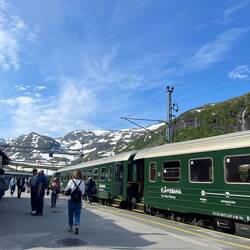
    We said goodbye to Flåm today and made our way to the Norwegian capital, Oslo. The first leg of the train journey was the traditional scenic Flam railway line up the mountain to the town of Myrdal. It has a lot of hairpins and goes through the mountains a lot so it was an amazing to think about the construction of the roads and railway (the roads were built in the 1800s and the railway was built between 1923-1940). The railway is 20km long and it is one of the steepest standard gauge trains in the world (80%). There are 20 tunnels (and 18 of them were built by hand!) 20 is an important number for the railway because it also took about 20 years to build and cost around 20 million NOK (Norweigan currency).

    The views were very beautiful and we even were able to stop and get off the train at a waterfall!

    After the 45 minute trip, we changed trains onto the mainline to Oslo, arriving around 3pm in the main station. We walked to our Airbnb and had a chilled afternoon, doing some travel admin and shopping before cooking ourselves a stir fry for dinner. We then just watched some Netflix before going to sleep.
    Baca lagi

  • Flåm

    17 Jun 2023, Norway ⋅ ☀️ 20 °C

    We had our first ‘non-travel’ day in what felt like two weeks and so we enjoyed a sleep in followed by a yummy buffet breakfast! :)

    We then went on a kayak tour of the fjords at 10am which was made even more amazing by the incredible weather we had! We paddled for over 5km and our guide gave us some interesting ‘facts’ about the fjords. We learnt the scientific reason behind the formation of the fjords, which is that a glacier melted and effectively pushed the rock mountains away to open up the lake. The more traditional Norwegian reasoning behind this is that two trolls were fighting over the land, and the losing troll was dragged through the mountains - with the resulting imprint from his body being the fjord and opening in the valley!

    After kayaking, we chilled on the beach and did a bit of travel admin in the afternoon. It was great just to relax after a busy few weeks!

    We then went for dinner in the Viking brewery where we had the Viking platter paired with matching beers - absolutely delicious! We then chilled out and played some cards before bed :)
    Baca lagi

  • Bergen —> Flåm

    16 Jun 2023, Norway ⋅ ⛅ 20 °C

    We started our travel day (this combination of train, ferry and bus is called "Norway in a Nutshell") with a train from Bergen to Voss. This was quite a nice short train with pretty scenery though there were quite a few tunnels through the mountains. We then changed modes of transport in Voss to bus and caught the bus to Gudvangen. We had a very charismatic bus driver who was giving us fun facts along the way and we even made a stop at a very picturesque hotel with views over the mountains. We changed in Gudvangen to our last mode of transport for the day, a ferry. This ferry is electric and is recharged on either end of the journey. We stood at the top floor and enjoyed the beautiful views and weather.

    We had a beautiful view as we moved through the fjords, taking in the sights and waterfalls along the mountains as we made our way to our final destination for the day, Flåm. We checked into our hotel and then explored the town and visited the railway museum in relation to the famous Flåm train. We saw some very cool photos of the original trains and how the road was originally built through the mountains in the 1800s. The musesum also included models of the trains and further information about people who worked on the train.

    In the afternoon, we did a beer tasting in the afternoon in a Viking style brewery, followed by a delicious dinner in the hotel restaurant - we had a goat dish and pork cheeks for main followed by chocolate mousse and pannacotta for dessert.
    Baca lagi

  • Trolltunga Hike —> Bergen

    15 Jun 2023, Norway ⋅ ☁️ 18 °C

    We had breakfast (Norweigan style porridge with butter, sugar and raisins and hot chocolate) served in our tent after a very restful sleep at the top of the mountain!

    We left camp and commenced our hike back down, stopping at Trolltunga for one last look and some photos before continuing on. It was another lovely sunny day again and so it wasn’t long until the morning layers were stripped off as we continued down the mountain.

    We arrived back at the carpark around 2pm, where we then caught the short shuttle bus back to Odda. We had a late lunch and chilled out before picking up our big bags and catching the bus back to Bergen ((with the lovely views and ferry ride again). We had a some much needed showers before going to sleep to get some rest before a busy travel day tomorrow!
    Baca lagi

Dapatkan profil pengembaraan anda yang tersendiri

Percuma

QR code

FindPenguins untuk iOSFindPenguins untuk Android